

Mali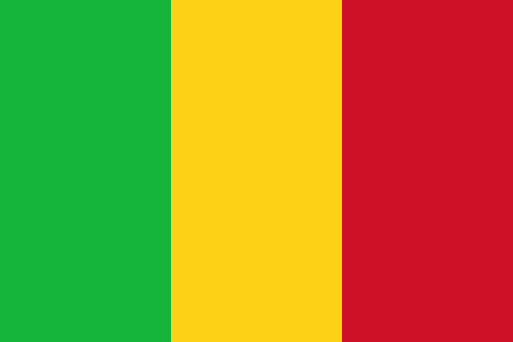
Foto von Rgaudin, Public domain, über Wikimedia Commons
Überblick
Mali (deutsch [ˈmaːli], französisch [maˈli], amtlich Republik Mali) ist ein Binnenstaat in Westafrika. In dem rund 1,24 Millionen km² großen Staat leben etwa 22 Millionen Menschen (Stand 2024), mehr als 4 Millionen davon in der Hauptstadt Bamako. Der größte Teil der Bevölkerung lebt im Südteil des Landes, der von den beiden Strömen Niger und Senegal durchflossen wird. Der Norden erstreckt sich bis tief in die Sahara und ist kaum besiedelt. Der Großteil der Bevölkerung sind Muslime. Insgesamt gibt es rund 30 verschiedene Ethnien sowie Sprachen in Mali. Auf dem Gebiet des heutigen Mali existierten im Laufe der Geschichte drei Reiche, die den Transsaharahandel kontrollierten: das Ghana-Reich, das Mali-Reich, nach dem der moderne Staat benannt ist, und das Songhai-Reich. Im goldenen Zeitalter Malis blühten islamische Gelehrsamkeit, Mathematik, Astronomie, Literatur und Kunst. Im späten 19.
Text aus Wikipedia, Lizenz CC BY-SA.
Wohin in Mali


Geheimtipps
Weniger bekannte Orte abseits der großen Städte von Mali, die Reisende auf Wikivoyage empfehlen: Dörfer, Nationalparks und ruhige Ecken. Die Kurzbeschreibungen stammen aus diesen Listen (CC BY-SA).

Feiertage
Landesweite Feiertage in Mali in den nächsten zwölf Monaten. Büros, Banken und viele Geschäfte schließen, Verkehr und Unterkünfte sind voller. Regionale Feiertage und lokale Feste sind nicht enthalten, und Feiertage nach dem Mondkalender können sich um einen Tag verschieben.
- Weihnachten · Noël
- Neujahr · Nouvel An
- Army Day · Fête de l'armée
- Zuckerfest · Fête de fin du Ramadan
- Martyrs' Day · Journée des Martyrs
- Ostermontag · Lundi de Pâques
- Tag der Arbeit · Fête du travail
- Opferfest · Fête du mouton
- Jour de l'Afrique
- Birthday of Muhammad (Mawlid) · Mawlid
- Unabhängigkeitstag · Fête nationale de l'indépendance
Daten aus dem Projekt date-holidays, größtenteils nach Wikipedia (CC BY-SA 3.0). Die Namen stehen in deiner Sprache, wo es eine Übersetzung gibt. Prüfe vor Ort, bevor du deine Reise danach planst.
Unterwegs in Mali
Dieser Teil ist auf Englisch, so wie er auf Wikivoyage steht.
Unterwegs im Land
By bus. The main cities along the paved road into the north are connected via bus (Bamako, Segou, San, Mopti, Gao). A separate paved loop runs through the south (Bamako, Bougouni, Sikasso, Koutiala, Segou) There are many different companies with different schedules but they all have more or less the same prices. Normally a ride to Mopti (600 km, half the way up), endures approximately nine hours; a ride to Gao at least 12. All times are very rough, however, and few bus companies will even give you an estimated arrival time as different drivers drive different speeds and it is not improbable that the bus breaks down and needs a repair or stops to help another bus. It is usually possible to make a reservation several days before, recommended during the tourist season, though one rarely has a problem just showing up 30-60 minutes before the bus leaves. More reliable companies include Bittar, Bani and Banimonotie (Sikasso region) among others. Bus companies: Bittar Transportation
By taxi brousse. To get around one can take the "Taxi - Brousse", the bush taxis. They are the main connection between towns which aren't connected via bus. They are very slow and they sometimes break down or stop to help other broken down taxis. So sometimes the ride takes longer than expected.
By taxi. In any larger city, taxis will be plentiful and are usually an easy way for the tourist to get where they are going without trying to figure out the local public transport system (if one even exists).
Geld und Kosten
Money. The currency of the country is the West African CFA franc, denoted CFA (ISO currency code: XOF). It's also used by seven other West African countries. It is interchangeable at par with the Central African CFA franc (XAF), which is used by six countries. Both currencies are fixed at a rate of 1 euro = 655.957 CFA francs. The West African CFA franc is envisioned to be reformed into the "eco" as the unified currency of all West African countries (the CFA is mainly used by former French colonies in the region). As of 2023, the change is planned for 2027.
Shopping. There are plenty of crafts in Mali. Various ethnic groups have their own, trademark masks. There are some great musical instruments; blankets; bogolas (a type of blanket); silver jewellery, and leather goods. The Touareg people, in particular, produce attractive silver and leather goods, including jewellery, daggers, spears, swords and boxes. Local music also makes good souvenirs.
ATMs. All Ecobank ATMs in Mali take Mastercard and Visa card for cash withdrawal. A list of locations is shown on their web site.
Sprache
In a constitutional reform in 2023, French was demoted from its official language status, but it remains the lingua franca for communication between ethnic groups. Bambara (or Bamanankan in the language itself), along with numerous other African languages (Peulh/Fula, Dogon, and Tamashek, the language of the Tuareg people), are spoken by 80% of the population. Few people speak French outside bigger towns, and even Bambara gets rare in some regions. Very few people speak English. A Songhai phrasebook is available on the French Wikivoyage.
Sitten und Umgangsformen
Greeting people is very important. You should get familiar with the greetings in French or, better, in Bambara. Vendors should be treated in a proper way, even when you buy just fruit or bread. It is very important to show a general interest in the other person, so ask about family, work, children, and so on. The answer is simple: "Ça va" (It's all right). The interlocutor should not answer in a negative way. Example: "Bonjour. ça va?" (Good morning. Are you all right)? "Et votre famille?" (And your family?) "Et vos enfants?" (And your children?) "Et votre travail?" (And your job?). The history of French colonial rule, and subsequent French domination even following independence, is a sensitive topic. Anti-French sentiment has been rising since the late 2010s, though it is generally the French government and French corporations, not individual French tourists, who are the subject of public anger. On the other hand, pro-Russian sentiments have also been on the rise, and many Malians are grateful to the Russians for their help in expelling the French military from Mali.
Sicherheit
Mali is politically unstable and therefore lawlessness is wide spread. In June 2012, Mali was hit by a political crisis and a civil war, which temporarily split the country into two parts: the north being named as "Azawad" and being controlled by a group of Islamist rebels, whilst the south experienced a military junta. Travelling in Timbuktu and Gao provinces is particularly dangerous, and as of July 2012, the Islamist rebel groups have ordered all shrines which are considered to involve idolatry to be destroyed. The U.S., Canada and Australia travel advisories have since continued to advise against all travel to Mali at this time. The UK government advises against all travel outside of Bamako. The train between Bamako and Kayes is notorious for theft: if taking the train, you should exercise extreme caution, carry a pocket flashlight, and keep your belongings with you and valuables directly on your person at all times. You also have a good chance of encountering the police. They are generally mostly concerned with directing traffic and fining people for improper papers, so you have little to fear from them, but always at least carry a copy of your passport and visa (and preferably the original if it is kept in a secure manner). Carrying only a driving license is not sufficient and might lead to a ride to the police office unless you bribe your way out.
Aus dem Wikivoyage-Reiseführer, geschrieben von Reisenden (CC BY-SA), gekürzt. Für Einreise, Visa, Gesundheit und die aktuelle Sicherheitslage gelten immer die offiziellen Reisehinweise deiner Regierung (oben verlinkt).