

Papua-Neuguinea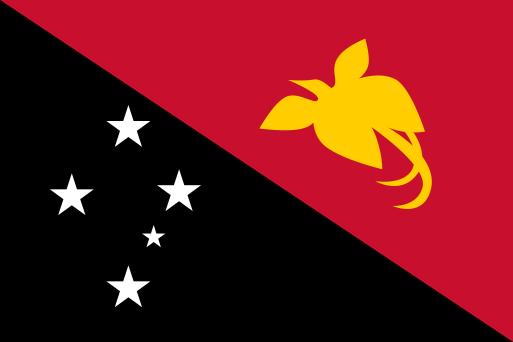
Foto von MSchlauch, Public domain, über Wikimedia Commons
Überblick
Papua-Neuguinea ([ˈpaːpu̯a nɔɪ̯giˈneːa], Tok Pisin Independen Stet bilong Papua Niugini) ist nach Indonesien und Madagaskar der flächenmäßig drittgrößte Inselstaat der Welt. Er liegt im Pazifik, wird zum australischen Kontinent gerechnet und umfasst den Osten der Insel Neuguinea (Westneuguinea gehört zu Indonesien) sowie mehrere vorgelagerte Inseln und Inselgruppen.
Text aus Wikipedia, Lizenz CC BY-SA.
Wohin in Papua-Neuguinea


Geheimtipps
Weniger bekannte Orte abseits der großen Städte von Papua-Neuguinea, die Reisende auf Wikivoyage empfehlen: Dörfer, Nationalparks und ruhige Ecken. Die Kurzbeschreibungen stammen aus diesen Listen (CC BY-SA).

Kainantu
5 Orte eingetragen
A missionary community in Eastern Highlands, which is home to the Summer Institute of Linguistics, a movement endeavouring to translate the Bible into all of PNG's languages

Louisiade Archipelago
1 Ort eingetragen
Beautiful island group well off-the-beaten-path; world-class diving and yachting heaven

Trobriand Islands
1 Ort eingetragen
Referred to by the anthropologist, Malinowski, as the "Islands of Love"

Tufi
1 Ort eingetragen
The Fjordland of Papua New Guinea with fascinating scenery, great diving, and tapa cloth made from mulberry bark
Mendi
2 Orte eingetragen
At 800 m above sea level this is considered to be one of the most beautiful spots in PNG. It also has considerable biodiversity and ecological significance
Namatanai
2 Orte eingetragen
Formerly cannibals, then heavily influenced by Roman Catholic missionaries, the biggest change for the people of the island came in the early 1980s when gold was discovered. The Lihir mine is estimated to hold 40 million ounces of gold, making it one of the largest in the world. The town of Londolovit is a mining town but the islanders remain spread out around the island in coastal villages. The Kunaye Beach Resort (Ph: +675 7939 2791) is at Londolovit. The economic importance of the mine is stressed by the fact that Air Niugini flies to Lihir (LNV) daily.
Unterwegs in Papua-Neuguinea
Dieser Teil ist auf Englisch, so wie er auf Wikivoyage steht.
Unterwegs im Land
By car. Papua New Guinea is a strange place when it comes to travel. The tropical conditions, fierce geography, and lack of government capacity means there are very few paved roads in the country, with a very messy road system. Most highways in PNG are not connected to one another. The big exception to this is the Highlands Highway, which begins in Lae (the country's main port) and runs up into the highlands through Goroka to Mt. Hagen with a fork going back to the coast and Madang. Shortly outside Mt. Hagen the road branches, with the southern line going through the Southern Highlands to Tari while the northern line runs through Enga province and ends in Porgera. On the north coast, a tenuous highway runs from Madang to Wewak only in theory, with a large gap between Gavien and Bak. With the exception of a brief span of road connecting it to the immediate hinterland and a road that will enable you to follow the coast southeast for a few hours, there are no major roads linking Port Moresby to anywhere else. Because it was administered by Australia until 1975, traffic in PNG drives on the left side of the road with right hand vehicles. The maximum speed limit is a very low 70 km/h.
By public motor vehicles (PMV). The most common way to travel is by PMV/bus with the locals. Lae, Madang, Goroka, Tari, and Mount Hagen are all connected by a good highway. As a newcomer it is probably advisable to get help from locals (e.g., hotel-staff). Most towns have several boarding points.
Geld und Kosten
Money. The kina, denoted by the symbol "K" (ISO code: PGK) is the currency of Papua New Guinea. It is divided into 100 toea. Polymer banknotes in Papua New Guinea come in denominations of 2, 5, 10, 20, 50 and 100 kina. Coins in Papua New Guinea come in denominations of 5, 10, 20 and 50 toea and 1 kina. ATMs are common in the main towns (mainly Bank of the South Pacific, ANZ and Westpac - all should accept foreign cards). Some will charge high fees, some might charge fees if you're in a different bank, and some in hotels might charge no fees (but are intended for guests only). The main bank ATMs include Kina Bank, Bank of South Pacific Bank (SPB) and Westpac. Normally there is a withdrawal limit of 2,000 Kina per day imposed on withdrawals for cards but this can vary depending on the bank and ATM. Some banks may have a lower withdrawal limit or be unable to process the transaction depending on the type of bank card. There is a Kina Bank and SBP ATM at the international airport arrival area, as you exit customs. However, some international cards may not work with these ATMs. Money changers give poor rates (similar rates to money changers in Australia) due to high business costs. Credit cards are commonly accepted in larger shops, hotels and restaurants, although there are occasional reports of fraud. Market stalls prefer small change. In some tourist spots, Australian dollars are accepted, although unlike other countries in Oceania, they may not always be preferred.
Sprache
With over 800 languages, it was pretty difficult to get everyone talking to each other. Two pidgins grew up in this area; Tok Pisin (based on English) and Hiri Motu (based on the local Motu language), and when the Anglophones married the Hulis and the babies learned the only language they had in common, Tok Pisin became a creole. Tok Pisin sometimes looks like it is English written phonetically ("Yu dring; yu draiv; yu dai" means "You drink; you drive; you die"), but it is not; it has more personal pronouns than English and its own quite different syntax. Tok Pisin is spoken in most of the country and short, inexpensive guidebooks on learning Tok Pisin can be acquired in the many bookstores.
Sitten und Umgangsformen
As in many Melanesian cultures, greeting people with a friendly handshake is very important. Be aware, however, that it is a sign of respect not to make eye contact. The sight of hotel staff calling you by name, shaking your hand and looking at the floor may seem unusual at first. Of course, do not take pictures of people without their consent, even if they have the most mindblowing clothing and makeup. Remember that they are real people, not tourist attractions.
Telefon und Internet
Papua New Guinea has 2 mobile GSM operators: Digicel PNG bmobile-Vodafone There is 4G LTE coverage in the capital, Port Moresby and Lae and 3G/2G coverage in most populated places.
Sicherheit
U.S. State Department travel advisory as of January 17, 2024: Reconsider travel to Papua New Guinea due to crime, civil unrest, and piracy. Exercise increased caution due to kidnapping, unexploded ordnance, inconsistent availability of healthcare services, and potential for natural disasters. Some areas have increased risk. Do not travel to: Central Bougainville, particularly areas near the Panguna mine, due to civil unrest. The Highlands region, other than the towns of Mt. Hagen and Goroka, due to civil unrest. The U.S. government has limited ability to provide emergency services to U.S. citizens outside of Port Moresby due to limited transportation infrastructure. U.S. government employees must obtain authorization before traveling to areas of concern, including the central part of Bougainville and the provinces of Southern Highlands, Western Highlands (excluding Mt. Hagen), Eastern Highlands (excluding Goroka), Hela, Enga, Jiwaka, and other areas of Papua New Guinea where one is unable to fly directly. The country has a reputation as a risky destination in some circles (primarily Australian ones), predominantly because of the activities of criminal gangs (known in Tok Pisin and commonly in English as raskols) in major cities, especially in Port Moresby and Lae. That is generally a result of unemployment stemming from increased domestic migration from subsistence farming in the hills to the nearest urban area.
Aus dem Wikivoyage-Reiseführer, geschrieben von Reisenden (CC BY-SA), gekürzt. Für Einreise, Visa, Gesundheit und die aktuelle Sicherheitslage gelten immer die offiziellen Reisehinweise deiner Regierung (oben verlinkt).