

Togo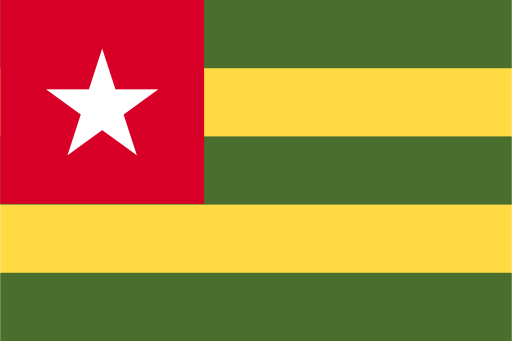
Foto von Reich geck, CC BY 4.0, über Wikimedia Commons
Überblick
Togo (deutsch [ˈtʰoːgo], französisch [tɔˈgo]) ist ein Staat in Westafrika, am Golf von Guinea gelegen, und grenzt an Ghana im Westen, Benin im Osten und Burkina Faso im Norden. Hauptstadt und Regierungssitz ist Lomé. Das Staatsgebiet von Togo umfasst den östlichen Teil der von 1884 bis 1916 bestehenden deutschen Kolonie Togo. Von 1916 bis 1960 war Togo Mandatsgebiet des Völkerbunds bzw. Treuhandgebiet der Vereinten Nationen unter französischer Verwaltung. Der autokratisch regierende Präsident Gnassingbé Eyadéma prägte das Land fast 40 Jahre lang. Nach dessen Tod 2005 ernannte die Armee seinen Sohn Faure Gnassingbé unter Missachtung der Verfassung zum neuen Präsidenten. Internationaler Druck und Unruhen im Lande führten nicht zur Rückkehr verfassungsgemäßer Zustände.
Text aus Wikipedia, Lizenz CC BY-SA.
Wohin in Togo


Geheimtipps
Weniger bekannte Orte abseits der großen Städte von Togo, die Reisende auf Wikivoyage empfehlen: Dörfer, Nationalparks und ruhige Ecken. Die Kurzbeschreibungen stammen aus diesen Listen (CC BY-SA).

Feiertage
Landesweite Feiertage in Togo in den nächsten zwölf Monaten. Büros, Banken und viele Geschäfte schließen, Verkehr und Unterkünfte sind voller. Regionale Feiertage und lokale Feste sind nicht enthalten, und Feiertage nach dem Mondkalender können sich um einen Tag verschieben.
- Weihnachten · Noël
- Neujahr · Nouvel An
- Liberation Day · Jour de la libération
- Zuckerfest · Fête de fin du Ramadan
- Ostermontag · Lundi de Pâques
- Unabhängigkeitstag · Jour de l’Indépendance
- Tag der Arbeit · Fête du travail
- Christi Himmelfahrt · Ascension
- Opferfest · Fête du mouton
- Pfingstmontag · Lundi de Pentecôte
- Day of the Martyrs · Journée des Martyrs
- Birthday of Muhammad (Mawlid) · Mawlid
- Mariä Himmelfahrt · Assomption
- Allerheiligen · Toussaint
Daten aus dem Projekt date-holidays, größtenteils nach Wikipedia (CC BY-SA 3.0). Die Namen stehen in deiner Sprache, wo es eine Übersetzung gibt. Prüfe vor Ort, bevor du deine Reise danach planst.
Unterwegs in Togo
Dieser Teil ist auf Englisch, so wie er auf Wikivoyage steht.
Unterwegs im Land
A taxi-moto (motorcycle taxi) will cost CFA 150-500 to get you around. You can tell who the taxi-moto drivers are: they will honk or hiss at you as they drive by and usually wear baseball caps and sunglasses. A taxi will usually cost about CFA 500 for a one-way short trip inside the city, for trips to the northern parts of the city expect to pay up to CFA 2,500. Taxis will have yellow licence plates and their registration number painted on the car. Always negotiate before you get on/in, the quoted price will include tip. Sometimes, when you are on a side street, it might be helpful if you ask a security guard to wave down a taxi for you. Tipping CFA 300-600 is expected.
By train. There is no train service in Togo.
Geld und Kosten
Fetish Market]]
Money. The currency of the country is the West African CFA franc, denoted CFA (ISO currency code: XOF). It's also used by seven other West African countries. It is interchangeable at par with the Central African CFA franc (XAF), which is used by six countries. Both currencies are fixed at a rate of 1 euro = 655.957 CFA francs. The West African CFA franc is to be renamed the "eco" by the end of 2027. It would continue to be fixed to the euro.
ATMs. All Ecobank and Banque Atlantique ATMs in Togo take Master card and Visa card for cash withdrawal.
Costs. A liter of gasoline will cost you around CFA 600, a liter of water around CFA 300. A baguette is around CFA 175 and half a pound of local coffee will cost CFA 1,200. A beer in the supermarket will cost you around CFA 350, at an expat restaurant this will be around CFA 1,000. A Coca-Cola will cost you CAF 200-400 in the supermarket. "Western food", mostly imported from France, can be found in supermarkets, but is more pricey than in Europe.
Markets. The most popular souvenirs from Togo tend to be something voodoo related, like a charm or mask. The obvious place to shop for these curios is Lomé's voodoo market, although you will be paying tourist trap-premium prices.
Sprache
French is the national language and the lingua franca between ethnic groups. Virtually no English is spoken in the whole of the country, aside from business offices and major banks in the capital. Ewe is far and away the most widely spoken native language, with the Ewe people populating the southern half of the country. You may also come across the related Mina language in the area around Aneho. Kabiyè is the predominant language of the north.
Sitten und Umgangsformen
Greetings are a little more elaborate in Togo. Say hello to everyone when coming and going. Handshakes are key. Also, maybe if you try to get to know them, you will fit in. Make sure you make yourself feel like you are at home. Don't make it too homey, though, because you don't want to get on their bad side.
Telefon und Internet
From some time after 2011, telephone numbers throughout Togo have changed from 7 to 8 digits. The original 7 digit numbers are no longer working in May 2013. Fixed line numbers have an additional 2, so for example, a Lomé number 2## ## ## becomes 22 ## ## ##. Togo Cellulaire, old numbers of the format 9## ## ## become 90 ## ## ##, 0## ## ## and 8## ## ## both are now 91 ## ## ## (the 0 and 8 are both replaced with 91), 7## ## ## becomes 92 ## ## ##. For Moov, numbers starting with 0, 6 or 8 this first digit is replaced by 98 (example: 6## ## ## becomes 98 ## ## ##), numbers starting with 5, 6 or 9 this first digit is replaced by 99 (example: 5## ## ## becomes 99 ## ## ##). Lomé has Internet cafes, and they are cheap. You buy time by the hour, but most of the cafes feature very slow computers and internet connection speeds. You also have quite a lot of "wifi zones", charging from CFA 100 for an hour to CFA 2000-3000 for a month. You can buy calling cards along the street. It is, however, much cheaper for people in the United States to call with their calling cards to a Togo cell phone.
Sicherheit
As a rule, stay away from public beaches, where tourists find themselves mugged any time of day or night. Most of the country has little crime, but Lomé is a clear exception, and is a good deal more dangerous than any city in Ghana or Benin. If going somewhere at night, take a car taxi, and get the numbers of a few trusted taxi drivers if you plan to stay for a while. Driving is atrocious in Togo, with fatalistic overloaded speed demons chancing it on curves and hills, capital streets swarming with motorcycles throughout the black of night, and worrisome accident scenes along the main roads. The hilly north-south road north of Kara is particularly dangerous. If you are skeptical, take a day trip, and marvel at all the husks of buses and trucks that weren't there on the way out! Traffic is the single biggest danger to travelers in Togo.
Aus dem Wikivoyage-Reiseführer, geschrieben von Reisenden (CC BY-SA), gekürzt. Für Einreise, Visa, Gesundheit und die aktuelle Sicherheitslage gelten immer die offiziellen Reisehinweise deiner Regierung (oben verlinkt).