

Vietnam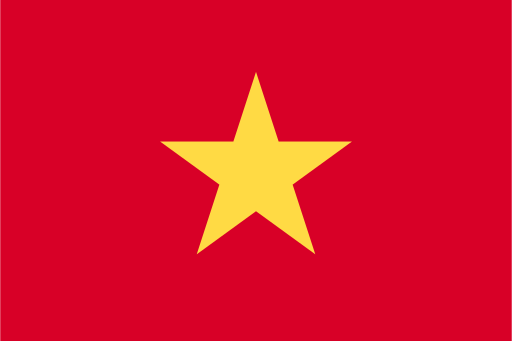
Foto von The original uploader was Chuoibk at English Wikipedia., CC BY-SA 3.0, über Wikimedia Commons
Überblick
Vietnam ([vi̯ɛtˈna[ː]m], vietnamesisch Việt Nam [in Hanoi viɜʔt̚˧ˀ˨ʔ naːm˧˧], Bedeutung „Viet des Südens“, amtlich in Deutschland und Österreich Sozialistische Republik Vietnam, in der Schweiz Sozialistische Republik Viet Nam, vietnamesisch Cộng hòa Xã hội chủ nghĩa Việt Nam [in Hanoi kɜwŋ͡m˧ˀ˨ʔ hwaː˨˩ s̪aː˦ˀ˥ hoj˧ˀ˨ʔ ṯɕu˧˩ ŋiɜ˦ˀ˥ viɜʔt̚˧ˀ˨ʔ naːm˧˧]) ist ein langgestreckter Küstenstaat in Südostasien. Er grenzt an China, Laos, Kambodscha, den Golf von Thailand und das Südchinesische Meer. Die Landeshauptstadt ist Hanoi und die größte Stadt nach Einwohnern ist Ho-Chi-Minh-Stadt. Weitere bedeutende Metropolen des Landes sind Hải Phòng, Huế, Cần Thơ, Đà Nẵng, Đồng Nai und Quảng Ninh. Die Mehrheit der Bevölkerung sind Vietnamesen. Das erste historisch belegte Königreich auf dem Gebiet des heutigen Vietnam entstand im 1. Jahrtausend v. Chr.
Text aus Wikipedia, Lizenz CC BY-SA.
Wohin in Vietnam


Geheimtipps
Weniger bekannte Orte abseits der großen Städte von Vietnam, die Reisende auf Wikivoyage empfehlen: Dörfer, Nationalparks und ruhige Ecken. Die Kurzbeschreibungen stammen aus diesen Listen (CC BY-SA).

Sa Pa
30 Orte eingetragen
A region to meet native indigenous people in the hills by the Chinese border

Ninh Binh
26 Orte eingetragen
Ha Long Bay-like karst scenery along the river

Dong Van Karst Plateau Geopark
24 Orte eingetragen
Steep and rugged limestone mountains shared by a number of ethnic groups

Cuc Phuong National Park
14 Orte eingetragen
Home to some of Asia's rarest wildlife and the Muong hill people

Con Dao
13 Orte eingetragen
Islands off the Mekong Delta

Cat Tien National Park
6 Orte eingetragen
A major protected area of lowland rainforest about 150 km north of Ho Chi Minh City.

Chàm Islands
4 Orte eingetragen
7 islands that are 17 km (9 nautical miles) offshore to the East of Hoi An river-ocean inlet

Ba Be National Park
2 Orte eingetragen
Scenic mountains and the beautiful Ba Bể Lake

Bai Tu Long Bay
1 Ort eingetragen
An alternative to the crowded Ha Long Bay, but less scenic

Cu Chi
1 Ort eingetragen
The site of the Cu Chi Tunnels

Co To Island
Noch keine Orte eingetragen
Visit natural forests, lighthouses, park

My Son
Noch keine Orte eingetragen
UNESCO World Heritage listed ruins of temples built by the ancient Champa civilisation, located close to Hoi An

Na Meo
Noch keine Orte eingetragen
A border crossing town

Tuan Chau Island
Noch keine Orte eingetragen
Well known for its entertainment and recreation activities
Feiertage
Landesweite Feiertage in Vietnam in den nächsten zwölf Monaten. Büros, Banken und viele Geschäfte schließen, Verkehr und Unterkünfte sind voller. Regionale Feiertage und lokale Feste sind nicht enthalten, und Feiertage nach dem Mondkalender können sich um einen Tag verschieben.
- Neujahr · Tết Dương lịch
- Vietnamese New Year Holidays · Giao thừa Tết Nguyên Đán
- Vietnamese New Year · Tết Nguyên Đán
- Hung Kings Commemorations · Giỗ tổ Hùng Vương
- Day of liberating the South for national reunification · Ngày Giải phóng miền Nam
- Tag der Arbeit · Quốc tế Lao động
- National Day · Quốc khánh
Daten aus dem Projekt date-holidays, größtenteils nach Wikipedia (CC BY-SA 3.0). Die Namen stehen in deiner Sprache, wo es eine Übersetzung gibt. Prüfe vor Ort, bevor du deine Reise danach planst.
Unterwegs in Vietnam
Dieser Teil ist auf Englisch, so wie er auf Wikivoyage steht.
Unterwegs im Land
By train. Trains are undoubtedly the most comfortable and an exciting way to travel overland in Vietnam. Due to the steady increase of tourist bus prices, trains are now an inexpensive alternative to buses. While a night in a sleeper carriage is still more expensive than a sleeper bus, seat carriage prices are very competitive.
Destinations. There is one major train line in Vietnam, the trunk between Hanoi and Ho Chi Minh City (HCMC), on which the Reunification Express runs. HCMC to Hanoi is more than 30 hours, and overnight hops between major destinations are usually possible, if not entirely convenient. It is a good way to see the countryside and meet upper-middle class locals, but unless you are travelling in a sleeper car it is no more comfortable than buses. Besides riding the full route from Hanoi to HCMC, major cities such as Vinh, Hue, Da Nang, and Nha Trang, are served by the reunification express, and are good cities to stop along the way if you plan on riding the route all the way to HCMC. In addition, there are shorter routes from Hanoi leading northwest and northeast, with international crossings into China. One of the most popular of the shorter routes is the overnight train from Hanoi to Lao Cai (with a bus service from Lao Cai to the tourist destination of Sapa).
Seats and carriages. Air conditioned soft or hard sleeper berths are recommended for overnight trains. Otherwise air-conditioned soft seats are sufficiently comfortable to travel in them during the day.
Geld und Kosten
Money. The national currency is the dong (đồng), sometimes denoted by the symbol "₫" (ISO code: VND). Prices are usually shown without a currency notation, e.g. as "100.000", "100k" or "100K", and in speech it's common to drop the thousands completely. Wikivoyage articles will use dong to denote the currency. Notes are available in denominations of 1,000, 2,000, 5,000, 10,000, 20,000, 50,000, 100,000, 200,000 and 500,000 dong. Smaller bills and coins in denominations up to 5,000 dong also exist, but are rarely seen. While they are legal tender, they are difficult to get rid of if you end up with some.
ATMs. ATMs are common and can be found in most cities and every tourist destination. They will accept a selection of credit and debit cards, including Visa, MasterCard, Maestro or Cirrus and several other systems. Many ATMs charge a fee per withdrawal, but a few are free. Withdrawal maximums are a problem of the past and withdrawing 5–10 million dong is not an issue anymore. To ensure you get at least some smaller note sizes, withdraw for example 4.9 million instead of 5 million. If you withdraw 5 million, you will likely receive ten 500,000 dong notes.
Credit/debit cards. Credit/debit cards are now accepted more and more around the country, especially where there is a lot of tourists present. Credit/debit card purchases are required by law to be charged in dong. A train ticket is easily payable with a credit card through the official government website for example.
Sprache
The official language of Vietnam is Vietnamese (Tiếng Việt). Vietnamese is a tonal language that uses a change in pitch to inflect different meanings, and this can make it difficult to master. Travellers may still be surprised to learn that the basic grammar is pretty simple. Verbs are static regardless of the past or future and parts of speech are pretty straightforward. The major difficulties lie in the pronunciation of the various tones and some of the sounds. Vietnamese is an Austroasiatic language that is related to Khmer, though the two languages are not mutually intelligible.
Sitten und Umgangsformen
In traditional Vietnamese culture, elders are treated with great deference and respect. While expectations are more relaxed when foreigners are involved, it's a good idea to show politeness, respect and restraint towards those who look older than you. It's common to be stared at by locals in some regions, especially in the rural areas outside of big cities, and in the central and northern parts of the country. Southerners are usually more used to foreigners. Wherever you are, though, expect some probing questions whenever a conversation starts: How old are you? Are you married? Do you have children? While these might seem nosy in the West, they're perfectly normal, good-natured questions here that help people determine how they should address you. The best thing to do is just play along. You probably don't know much about their culture; it's only fair that locals wouldn't know much about yours. An Asian woman travelling with a non-Asian man may attract unwanted attention. As of April 2019 these prejudices have almost completely disappeared, but some assumptions linger — rooted partly in memories of the American War era — and she may occasionally be treated dismissively or spoken to rudely. A more common experience today is simply that locals will assume she is Vietnamese and address her in Vietnamese rather than English, regardless of where she's actually from.
Politics. Relations with China are a sensitive issue best not discussed with locals.
Telefon und Internet
Telephone. Land-line numbers in Hanoi and HCMC have a sequence of eight numbers, others have seven. Vietnam international code: +84 Hanoi area code: (24) Ho Chi Minh area code: (28); VoIP calls Telephone bills are 30% to 40% cheaper if dialed with 171 or 178 services. Domestic call: 171 (178) + 0 + Area code + Number. International call: 171 (178) + 00 + Country code + Area code + Number. Since hotels and guesthouses often charge higher for telephone calls, try to find a post office or any reliable public service.
Mobile phones. Mobile numbers in Vietnam must always be dialed with all 9 or 10 digits (including a "0" prefixing the "1nn" or "9nn" within Vietnam), no matter where they are being called from. The 1nn or 9nn is a mobile prefix, not an "area code", as such and the second and sometimes third digits (the nn part) denotes the original mobile network assigned. As is the case with most mobile numbers, they can also be called within or outside Vietnam using the international format.
Useful numbers. Police 113 Fire Brigade 114 Hospital 115 General Information 1080
Internet. Wi-Fi is widespread in Vietnam and most hotels, restaurants and bars in the main tourist centres have free Wi-Fi.
Sicherheit
Vietnam has made a huge leap forward in terms of economic development and tourism, and many of the most feared annoyances are minor concerns. Vietnam is still a poor country, though. Tourists are considered money mules, and milking them is no crime. Nevertheless, outside of tourist hotspots, crime and scams against foreigners are rare.
Unexploded ordnance. As a legacy of the Indochina Wars, much of Vietnam's countryside is still littered with unexploded bombs and landmines, and many locals are still killed or maimed by them. Be very careful about going off the beaten path in rural areas, and ideally do not do so unless you have a guide who knows the area well.
Crime. Vietnam is a relatively safe place for tourists, especially when travelling in groups. It will also depend on your nationality whether you may encounter issues — large western men are much more intimidating than smaller Japanese women, see cyclo scam. Tourist areas are hotspots of petty crime. Violent crime towards foreigners is uncommon, but pickpockets and motorbike snatching are not uncommon in larger cities. Thieves on motorbikes snatch bags, mobile phones, cameras, and jewellery from pedestrians and other motorbike drivers. Don't wear your bag on your shoulder when riding a motorbike. Don't place it in the motorbike basket. When walking along a road, keep your bag on your inboard shoulder. If your bag is snatched, don't resist to the point of being dragged onto the roadway.
Aus dem Wikivoyage-Reiseführer, geschrieben von Reisenden (CC BY-SA), gekürzt. Für Einreise, Visa, Gesundheit und die aktuelle Sicherheitslage gelten immer die offiziellen Reisehinweise deiner Regierung (oben verlinkt).