

Cambodge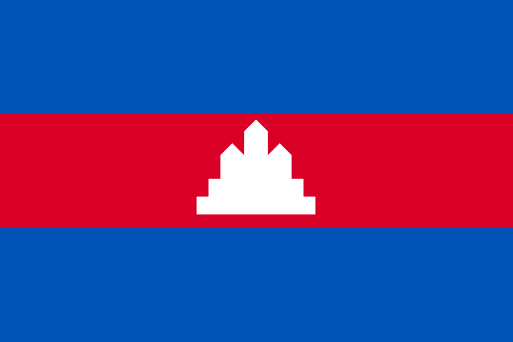
Photo de Manfred Werner (talk · contribs), CC BY-SA 3.0, via Wikimedia Commons
Présentation
Le Cambodge (en khmer : កម្ពុជា, romanisé en Kâmpŭchéa), ou en forme longue le royaume du Cambodge (en khmer : ព្រះរាជាណាចក្រកម្ពុជា, romanisé en Preăhréachéanachâkr Kâmpŭchéa), aussi appelé Srok Khmer, ស្រុកខ្មែរ, littéralement « le pays khmer », est un pays d'Asie du Sud-Est, peuplé d’environ 17 millions d'habitants. Sa capitale est Phnom Penh. Le Cambodge est une monarchie constitutionnelle, héritière de l’ancien Empire khmer hindou et bouddhiste qui régna sur la péninsule d’Indochine entre le XIe et le XIVe siècle. Le Cambodge a des frontières communes avec la Thaïlande au nord-ouest, le Laos au nord-est, et le Vietnam à l'est et au sud-est. Les habitants du pays portent le nom de Khmers ou Cambodgiens. La majorité des Cambodgiens sont de religion bouddhiste theravāda (96 % de la population, religion d'État).
Texte de Wikipedia, sous licence CC BY-SA.
Où aller en Cambodge


Trésors cachés
Des lieux moins connus que les voyageurs de Wikivoyage recommandent au-delà des grandes villes de Cambodge : villages, parcs nationaux et coins tranquilles. Les courtes descriptions viennent de ces listes (CC BY-SA).

Kep
36 lieux répertoriés
A seaside area which pre-dates Sihanoukville as the main beach resort in Cambodia; slowly being re-discovered by international travellers

Kampong Cham
26 lieux répertoriés
Nice countryside village on the Mekong river and good place to meet real Cambodia

Banteay Chhmar
17 lieux répertoriés
Quiet and remote temple complex

Koh Ker
11 lieux répertoriés
More ancient ruins, 120 km north of Angkor

Koh Rong
10 lieux répertoriés
The south islands off the cost of Sihanoukville, the most popular places in Cambodia for beach time.

Poipet
10 lieux répertoriés
Gritty border town that most overland visitors to Angkor pass through

Bokor National Park
7 lieux répertoriés
Ghostly former French hill resort

Koh Rung Sanloem
6 lieux répertoriés
Koh Rong Sanloem is an island off the coast of Sihanoukville, Cambodia, 4 km (2 mi) south of Koh Rong. It is around 9 km (6 mi) long, 4 km (2 mi) wide and 1 km (1 mi) wide at its narrowest point. Its distance from the local port of Sihanoukville is 25 km (16 mi) (beeline) and 23 km (14 mi) (beeline) from the Serendipity/Ochheuteal beach pier.

Preah Vihear
Aucun lieu répertorié pour l'instant
Cliff-top temple pre-dating Angkor
Koh Russei
4 lieux répertoriés
Koh Russei, Koh Russey or Bamboo Island is one of a group of small islands in the Gulf of Thailand, located about 4.5 km (3 mi) off the coast of Sihanoukville city in southern Cambodia. It is administered by Prey Nob District in Sihanoukville Province.
Virachey National Park
Aucun lieu répertorié pour l'instant
Is one of the largest protected areas in Cambodia, stretching for established in 1993.
Voyager en Cambodge
Cette partie est en anglais, telle qu'elle est écrite sur Wikivoyage.
Se déplacer dans le pays
By plane. The domestic aviation scene in Cambodia has improved. Three airports operate scheduled passenger flights: Phnom Penh, Siem Reap, and Sihanoukville. The main operator is Cambodia Angkor Air, a joint venture between the government and Vietnam Airlines, which flies between Phnom Penh, Siem Reap, Sihanoukville, and airports in China, Thailand, and Vietnam. A charter service, Aero Cambodia, operates from Phnom Penh to Cambodia's other 16 airports using twin engine 10-70 seat aircraft.
By bus. Longer journeys in Cambodia can be taken by bus, pickup truck or shared taxi. In many towns, whichever of these are available will be found at the local market square. Larger towns and cities will have bus stations. Buses may also serve their companies' offices, which may be more convenient than the bus station: this is particularly true in Siem Reap. Giant Ibis and Mekong Express have the best reputation for comfort, safety, and reliability and consequently charge a premium. Sorya (formerly Ho Wah Genting) and GST offer a slightly cheaper no-frills service. Capitol runs between its central offices, making for city centre-to-city centre travel. Ramshackled peasant mover Paramount Angkor Transport is great for accessing more remote places but low on comfort and safety. Check their rating and reviews on Google Maps when going with any of them. Guesthouses and travel agents will be able to arrange tickets for a US$1–2 commission.
Argent et coûts
Money. The Cambodian riel, denoted by the symbol "៛" (ISO code: KHR), and the United States dollar (USD) are both official currencies. The riel is used for regular transactions and payments. For large purchases however, locals will often prefer U.S. dollars. The National Bank of Cambodia is attempting to reduce dependence on the U.S. dollar and increase the use of the riel in local transactions; U.S. dollar coins are not accepted, and U.S. dollar bills of under $10 in value are no longer legal tender. As of 2024 though, US$1 and US$5 bills are still widely accepted and handed out everywhere. However, unlike the 2010s when the riel was largely limited to small change, you can go a day without touching a dollar, and there is no disadvantage to using the riel in most day-to-day transactions. Banknotes of Cambodia are issued in denominations of 50, 100, 200, 500, 1,000, 2,000, 5,000, 10,000, 20,000, 50,000, 100,000 and 200,000 riel. There are also banknotes in denominations of 15,000 and 30,000 riel, but they are valued more as collector's pieces than as circulating currency. The National Bank of Cambodia maintains the riel at around 4,100 riel to the U.S. dollar. In day-to-day commerce, 4,000 riel per dollar is ubiquitous. So, a US$1.50 amount can be paid with one dollar and 2,000 riel, or with 6,000 riel. Riel don't have value outside of Cambodia apart from being souvenirs; get rid of them before leaving. But don't worry, they can easily be changed into U.S.
Langue
See also: Khmer phrasebook The official language of Cambodia is Khmer (ភាសាខ្មែរ phiəsaa khmae), which unlike most languages in the region is not tonal, but makes up for it with a large assortment of consonant and vowel clusters. It is an Austroasiatic language that is related to Vietnamese, but the two languages are not mutually intelligible. Vietnamese was more influenced by Chinese, while Khmer was more influenced by Sanskrit. Many younger Cambodians have studied English in school, but proficiency is generally poor. That said, frontline staff in the tourism industry and business people who deal with international clients are usually able to speak English.
Coutumes et savoir-vivre
Cambodia is a country at a crossroads. While the more heavily touristed places like Phnom Penh and Siem Reap are well adjusted to tourist behaviour, people in places such as Stung Treng or Banlung are less so. Always ask permission before you take somebody's picture, as many in the more remote areas do not like to be photographed, and some in the urban areas will ask for payment. Dress for women is quite conservative in Cambodia. While shorts are now acceptable in Phnom Penh and Siem Reap, it is more respectful to wear knee length shorts or trousers when outside of these areas. While Cambodian women may prefer to dress conservatively in the daytime, covering much skin to prevent tanning, which they find unattractive, at night the dress code is more revealing. Do not mistake such local women in nightclubs for prostitutes; they are out for a night on the town like anyone else. Beachwear is pretty conservative: speedos and bikinis are not common except among foreigners. Groups of young children can be found everywhere in Cambodia and many travellers feel 'pestered' by them to purchase their friendship bracelets and other wares. However, it's often the case that children enjoy the chance to practice their English on you- and by asking them their names and ages a conversation is likely to develop where the 'hard sell' is forgotten. Children and adults alike enjoy looking at photographs of your family and home country, so it might be a good idea to have some ready.
Téléphone et internet
Telephone. Cambodia uses the GSM mobile system and cellcard is the largest operator, then Smart then Metfone. Pre-paid SIM cards are widely available (from US$1). In Siem Reap you can buy them in airport outside near the entrance, prices seem to be relatively similar with different operators and in 2025 prices start from around 5USD for 30GB package (valid for 2 weeks), 8USD for 60GB for a month and up to ~20USD for 200GB for a month. You are required to show your passport at a carrier store to get a SIM. Mobile phone providers are the main exception to the "use riel instead of US dollars" rule stated in the "Buy" section above, as after a short-lived push to start pricing services in riel in 2022-2023, they have all returned to pricing services in US dollars. The way mobile calls are charged for has created an unusual side effect. Because most phone plan allowances only cover calls within the same network, many companies, hostels, etc. publish two or 3 mobile numbers for different networks and have 2 or 3 mobile phones with different network operator SIMs. Tuk-tuk drivers in Phnom Penh carry around 3 mobiles held as a "stack".
Sécurité
Theft. Cambodia is a reasonably safe country, with the usual exception for large cities late at night, particularly Phnom Penh, and with unobserved luggage or wallets. Bag and phone snatching along the road or when riding on a bicycles and motorbike is a problem in Phnom Penh. Never stand at the side of the road/traffic reading stuff on your phone — that's an invitation for thieves. Or sometimes people or drivers might follow you unnoticed and snatch your phone or belongings when it's the right time — so, it doesn't hurt to look behind or around you from time to time to observe if someone is following you. Be discreet with your possessions, especially cash and cameras, and take extra care in all poorly lit or more remote areas. Also, never leave money in your room, even if you just go to the toilet for a brief moment — this seems to be the most common case when money gets stolen.
Crime and corruption. The rule of law in Cambodia is inconsistently applied. Crimes usually require bribes to be investigated, and if perpetrators are wealthy or connected to the government they will often be untouchable by police and courts. You should also be aware that the courts are corrupt, so contracts are hard to enforce without some political leverage. All this being said, the violent crime rate is fairly low, the police are generally friendly and non-threatening, and those with common sense have little to fear besides a scam or two and perhaps some petty theft.
Scams. Scams of all sorts are plentiful in Cambodia.
D'après le guide Wikivoyage, écrit par des voyageurs (CC BY-SA), raccourci. Pour les règles d'entrée, les visas, la santé et la sécurité actuelle, consultez toujours les conseils officiels aux voyageurs de votre gouvernement (lien ci-dessus).