

Égypte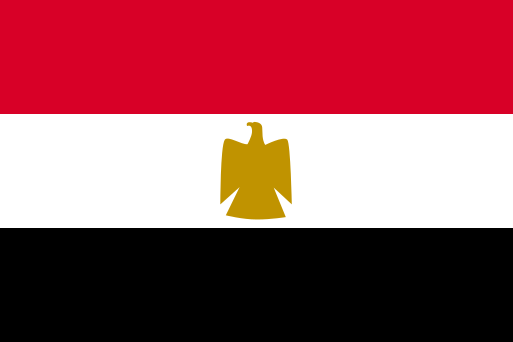
Photo de Ricardo Liberato, CC BY-SA 2.0, via Wikimedia Commons
Présentation
L'Égypte (en arabe : مصر / miṣr ; en arabe égyptien : مصر / maṣr /masˤɾ/), en forme longue la république arabe d'Égypte (en arabe : جمهورية مصر العربية, jumhuriyat masr al arabiya), est un pays transcontinental se trouvant en Afrique du Nord-Est et, pour la péninsule du Sinaï, en Asie de l'Ouest. Située sur la côte sud de la Méditerranée orientale, le bassin Levantin, le pays a des frontières terrestres avec la Libye à l'ouest, le Soudan au sud, la mer Rouge à l'est, et Israël et la bande de Gaza de la Palestine au nord-est. La capitale, ville la plus peuplée du pays, est Le Caire. L'Égypte est le troisième pays le plus peuplé d'Afrique derrière le Nigeria et l'Éthiopie et le pays arabe le plus peuplé. En 2026, le pays compte une population de 119 724 402 habitants. La surface du pays est largement recouverte par le Sahara et la population est fortement concentrée sur les rives du Nil.
Texte de Wikipedia, sous licence CC BY-SA.
Où aller en Égypte

Cairo
Égypte
Alexandria
Égypte
El Gouna
Égypte
Luxor
Égypte
Aswan
Égypte
Sharm el-Sheikh
Égypte
Hurghada
Égypte
Siwa
Égypte
Saint Catherine
Égypte
Port Said
Égypte
Mount Sinai
Égypte
Valley of the Kings
Égypte
Cairo/Giza
Égypte
Abu Simbel
Égypte
El Quseir
Égypte
Edfu
Égypte
Marsa Alam
Égypte
Kom Ombo
Égypte
Memphis
Égypte
Trésors cachés
Des lieux moins connus que les voyageurs de Wikivoyage recommandent au-delà des grandes villes de Égypte : villages, parcs nationaux et coins tranquilles. Les courtes descriptions viennent de ces listes (CC BY-SA).

Dahab
49 lieux répertoriés
At Sinai, east of Sharm el Sheikh, a backpacker central, with excellent scuba diving

Wadi El Gemal National Park
24 lieux répertoriés
Home to a variety of wildlife, including the endangered Nubian ibex and the endangered Egyptian vulture.

Taba Heights
15 lieux répertoriés
Purpose built resort with views of Israel, Jordan and Saudi Arabia

Amarna
7 lieux répertoriés
Site of the short-lived capital of the "heretic pharaoh" Akhenaten, best known for its rock-cut tombs

Abydos
6 lieux répertoriés
The site of magnificent Ramesside temples and Predynastic remains - accessed via the small town of al-Balyana

El-Ashmunein
2 lieux répertoriés
The main cult centre of Thoth, the Pharaonic god of magic, healing, and wisdom and the patron of scribes.

Dendera
1 lieu répertorié
Location of one of the best-preserved ancient Egyptian temples

Silsila
1 lieu répertorié
Are a range of sandstone hills with the popular royal quarries.

Beni Hasan
Aucun lieu répertorié pour l'instant
The location of fascinating tombs of the Middle Kingdom period

Gilf Kebir National Park
Aucun lieu répertorié pour l'instant
Famous for its beautiful natural landscapes and prehistoric drawings on the cliffs and rock caves.

White Desert National Park
Aucun lieu répertorié pour l'instant
Sahara el Beyda, the White Desert Protected Area, is a national park in Egypt, first established as a protected area in 2002. It is located in the Farafra depression, 45 km (28 mi) north of the town of Qasr Al Farafra. Part of the park is in the Farafra Oasis.
Wadi Allaqi
Aucun lieu répertorié pour l'instant
An important destination for ecotourism.
Jours fériés
Jours fériés nationaux en Égypte pour les douze prochains mois. Les bureaux, les banques et de nombreux magasins ferment, et les transports et hébergements sont plus fréquentés. Les fêtes régionales et locales ne sont pas incluses, et les fêtes qui suivent la lune peuvent bouger d'un jour.
- Noël · عيد الميلاد المجيد
- National Police Day · عيد الشرطة
- Revolution Day 2011 · عيد ثورة 25 يناير
- Fête de fin du Ramadan · عيد الفطر
- Sinai Liberation Day · عيد تحرير سيناء
- Fête du travail · يوم العمال
- Sham El Nessim · شم النسيم
- Fête du mouton · عيد الأضحى
- Nouvel an islamique · رأس السنة الهجرية
- 30 June Day · عيد ثورة 30 يونيو
- Revolution Day · يوم الثورة
- Mawlid · المولد النبويّ
- Armed Forces Day · عيد القوات المسلحة
Dates issues du projet date-holidays, basé en grande partie sur Wikipédia (CC BY-SA 3.0). Vérifiez sur place avant d'organiser votre voyage autour d'un jour férié.
Voyager en Égypte
Cette partie est en anglais, telle qu'elle est écrite sur Wikivoyage.
Se déplacer dans le pays
By plane. Overland journeys between cities in Egypt are often long, hot, bumpy, dusty, and not altogether safe. There is a good domestic air network, and advance fares are not expensive, so flying internally is often a good option. Cairo has direct flights to every other major city except Alexandria, including Luxor, Aswan, Abu Simbel, Hurghada, Sharm el-Sheikh, Marsa Matruh, Marsa Alam and Kharga oasis. These run at least daily, and the main cities have several flights a day. There are also daily flights directly between Alexandria, Aswan, Luxor, Hurghada and Sharm el-Sheikh. Most flights are operated by the national carrier, EgyptAir. This is the first place to go looking. Some internet booking sites (e.g. Expedia) don't offer their flights – it'll appear as if you need to fly via Istanbul or similar nonsense. Egyptair doesn't do phone sales, but they have lots of booking offices in the centres (your hotel can point these out), which saves you if you don't have internet access. There are rival airlines such as Nile Air and Al Masria. Nile Air has flights from Cairo and Alexandria. Al Masria flies to Cairo from Hurghada, and Sharm El Sheikh. Foreign package airlines (e.g. TUI) sometimes fly an internal route, but that's to move their clients around on multi-centre holidays, and they're not available to book as point-to-point domestic flights.
By train. Egypt's mainline railway follows the Nile: from Aswan north through Luxor to Cairo and Alexandria.
Argent et coûts
Money. The local currency is the Egyptian pound (ISO code: EGP), which is divided into 100 piastres. The currency is often written as LE (short for French livre égyptienne, or by using the pound sign £ with or without additional letters: E£ and £E. In Arabic, the pound is called genē [màSri] / geni [màSri] (جنيه [مصرى]), in turn derived from English "guinea", and piastres (pt) are known as ersh (قرش). Wikivoyage uses the "LE" notation for consistency, but expect to see a variety of notations in shops and other businesses. Coins: Denominations are 25pt, 50pt and 1 pound (silver ring with yellow center). You won't really need to know the name piastre, as the smallest value in circulation as of 2023 is 25 piastres, and this is almost always called a "quarter pound" (rob` genē ربع جنيه), and the 50 piastres, "half pound" (noSS genē نص جنيه). Banknotes: The banknote denominations in circulation in Egypt are 25 and 50 piastres; 1, 5, 10 (two versions, in paper and polymer), 20 (two versions, in paper and polymer), 50, 100 and 200 pounds. In Egypt, the pound sterling is called, genē esterlīni (جنيه استرلينى). The Egyptian pound was devalued dramatically in 2024 to bring the official rate in line with the black market rate. Prices quoted in Egyptian pounds in travel guides are usually out of date and therefore not reliable.
Money exchange. Banks and exchange offices or anyone who would exchange currencies, would slightly extra charge you for the official exchange rate.
Langue
The national spoken and dominant language is Egyptian Arabic – go for this if you want to be understood and perceived as a respectful visitor. The official language of Egypt is Modern Standard Arabic (MSA). There are multiple versions of Arabic, often referred to as "dialects", but effectively different languages, mostly mutually unintelligible. MSA is taught in schools and used in most written and official forms such as TV, newspapers, government speeches, teaching and education, and so is understood by literates, but you won't hear it in everyday speech. So you'd need to learn it to read the Qur'an, or to be a serious scholar of the language, but not for short visits.
Coutumes et savoir-vivre
Egyptians, in general, are friendly and welcoming. As is the case in many Muslim-majority countries, Egyptians consider it shameful to not give a guest a warm welcome. Egyptians, North Africans, and Arabs in the Gulf share a common culture and form the Arab world; therefore, much of what is considered good manners in Arab world is very much applicable to Egypt. First-time visitors to the Arab world should keep the following rule in mind: be smart about what you say or do openly. Any action that causes an Egyptian to lose their honour (face) will not be taken positively.
Social customs. Never admonish an Egyptian person directly, even if they have done something wrong in your opinion. If you must give feedback, give a mix of both positive and negative feedback. Religion is a delicate topic of discussion. Always approach religious discussions with sensitivity and respect. Talking about religion from a secular or agnostic point of view may be met with bewilderment. Also, anything hinting at proselytism will not be appreciated.
Greeting people. See also Egyptian Arabic phrasebook When you approach any individual or a group of people for the first time, the best thing to say is the local variation of the Islamic form of greeting "es-salāmu-`alēku" which literally means "peace be upon you". This is the most common form of saying "hello" to anybody. It creates a friendliness between you and people you don't know, builds rapport, and helps build respect!
Téléphone et internet
Egypt has a reasonably modern telephone service including four GSM mobile service providers. The mobile phone providers are Vodafone, Etisalat, We and Orange. According to OpenSignal all of them are similarly good. Actual 4G download speeds are around 15 MBit/s. Vodafone has the most consistent network quality. If you plan to visit rather remote areas, also Vodafone has the widest 4G coverage. (updated September 2022) While local SIM cards are available, this is not recommended as the Egyptian government introduced an import tax on all phones manufactured abroad. The tax amounts to 38.5% of the device's value and must be paid within 90 days, otherwise your phone will be locked out of all mobile services across all Egyptian providers. To avoid this issue and avoid paying the tax, use an international travel eSIM or foregin SIM card with roaming enabled. Internet access is easy to find and cheap, and often free. Nowadays, most coffee shops, restaurants, hotel lobbies and other locations now provide free WiFi. Connections can be unsafe and under surveillance, try to use a proxy or VPN for your privacy.
Sécurité
Egypt is often labelled as an unsafe country by many foreign governments — a reputation that's not entirely unwarranted — but the average traveller should not be too overly concerned or cautious of their surroundings. Travelling in Egypt is, more or less, similar to travelling in Morocco, Jordan, Palestine or Turkey. Perhaps the biggest safety concern is terrorism. The Sinai Peninsula in particular is a hotspot for terrorist activity.
Female travellers. Egyptian men will make compliments to women; do not take offence if they do this to you. Men should not be worried, either; if they do this to your partner or daughter it hopefully won't go any further than that. Be warned that foreign women often attract the attention of Egyptian men. Being overly friendly to or making direct eye contact with an Egyptian man may cause him to think that you're "into" him. Some men may inappropriately touch you. If this ever happens, don't be afraid to create a scene and don't feel the need to be polite; no woman should put up with rotten behaviour like that. Bystanders may come to your aid if prompted. One way to deter harassers: loudly say "haraam aleik" (lit. shame on you) or the simpler phrase "imshi" (lit. go away or get lost).
Political unrest. Egypt has a long history of political instability. Protests against the government can occur anytime, and they can turn violent. Many believe Abdel Fattah el-Sisi's (the current president) government is much more repressive than that of their previous president, Hosni Mubarak.
D'après le guide Wikivoyage, écrit par des voyageurs (CC BY-SA), raccourci. Pour les règles d'entrée, les visas, la santé et la sécurité actuelle, consultez toujours les conseils officiels aux voyageurs de votre gouvernement (lien ci-dessus).