

Aruba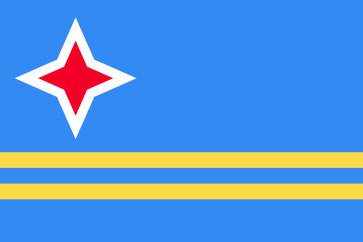
Photo by NASA World Wind, Screenshot by Carport, Public domain, via Wikimedia Commons
Overview
Aruba, officially the Country of Aruba, is an island constituent country within the Kingdom of the Netherlands, in the southern Caribbean Sea 29 kilometres (18 mi) north of the Venezuelan peninsula of Paraguaná and 80 kilometres (50 mi) north-west of Curaçao. In 1986, Aruba became a constituent country within the Kingdom of the Netherlands and acquired the official name.
Text from Wikipedia, licensed CC BY-SA.
Where to go in Aruba

Public holidays
National days off in Aruba in the next twelve months. Offices, banks and many shops close, and transport and stays get busier. Regional holidays and local festivals are not included, and holidays that follow the moon can move by a day.
- Christmas Day · Dia Pasco di Nascimento
- Boxing Day · Di dos Dia Pasco di Nascimento
- New Year's Day · Aña Nobo
- Betico Croes Day · Dia di Betico
- Shrove Monday · Dialuna di Carnaval
- National Anthem and Flag Day · Dia di Himno y Bandera
- Good Friday · Diabierna Santo
- Easter Monday · Di dos Dia Pasco di Resureccion
- Kings Day · Aña di Rey
- Labour Day · Dia di Obrero
- Ascension Day · Dia di Asuncion
Dates from the date-holidays project, based largely on Wikipedia (CC BY-SA 3.0). Check locally before you plan around a holiday.
Travelling in Aruba
Getting around the country
You can conveniently get around Aruba by car, bus, or by foot. As a tourist, it is not completely necessary to rent a car because many restaurants, beaches, and shopping areas are within walking distance. If something is not within walking distances, taxis are always available and the ride is never very long. There is also a bus line that can take you close to major tourist areas.
By car. Like most Caribbean islands, Aruba's transportation network consists primarily of two-lane paved roads. Oranjestad is often jammed with traffic when Aruba is full of tourists. For much of Aruba's history, Oranjestad lacked an inland bypass; the island road network was so disorganized that any attempt to bypass Oranjestad by detouring inland took as long as sitting in Oranjestad traffic. On November 5, 2019, the Aruba government opened Watty Vos Boulevard, a modern four-lane arterial road which provides a high-speed inland bypass route for travelers bound from the airport for points north of Oranjestad.
By car hire. Although the island has a half-decent transport system, you can take life on this laid-back island at a pace that suits you by using a car hire vehicle. Take a map with you to determine what road signs mean because they are not immediately obvious. This is one of the easier holiday destinations to negotiate your own car around so keep the pace easy and book ahead online. Because Aruba is small, consider not renting a car until you know what you want to do.
Driving in Aruba. The most important thing U.S.
Money and costs
Money. The currency used is the Aruban florin (or guilder in Papiamentu), denoted by the symbol "ƒ" or Afl (ISO currency code: AWG). The official rate at which banks accept U.S. dollar banknotes is ƒ1,77 and checks at ƒ1.78. The rate of exchange granted by shops and hotels ranges from ƒ1.75 to ƒ1.80 per U.S. dollar. U.S. dollars are widely accepted in Aruba, and banks may exchange other foreign currency. Coins in Aruba come in denominations of 5-, 10-, 25 and 50 cents, ƒ1-, ƒ2, and ƒ5. Banknotes in Aruba come in denominations of ƒ10-, ƒ25-, ƒ50-, ƒ100 and ƒ200. Traveler's checks are widely accepted and there is no charge for using them in hotels, restaurants and stores. Major credit cards are accepted at most establishments while personal checks are normally not accepted. Cash may be obtained with MasterCard, Visa and American Express cards at credit card offices, banks, in some casinos and via Western Union. ATM cards and credit cards are accepted by ATMs of Aruba Bank, Banco di Caribe, RBTT Bank, and Caribbean Mercantile Bank. The card must have either a Cirrus or Visa Plus logo. ATM instructions are normally given in Dutch, English, Spanish and Papiamento. Cash is normally dispensed in local currency. American dollars are accepted virtually everywhere at a decent exchange rate. If you have U.S. dollars, there is no need to change money into the local currency, the Aruban florin.
Language
Languages spoken are Dutch (official), Papiamento (also official, it's a creole of Spanish, Portuguese, and Dutch), Spanish, and English (widely spoken).
Customs and manners
Nature is very cherished by the Aruban people. 18% of their island is dedicated to the Arikok National Park. You should not wear beach attire anywhere but on the beaches or by the pool. Make sure to properly greet someone. Ask before snapping a picture of someone. Men should wear dress shorts or slacks to dinner, no jeans allowed in most restaurants.
Staying safe
Aruba is generally a very safe place at any time of day or night. However, it would probably be wise to stay away from the area surrounding the Citgo refinery on the southeast part of the island at night (in the words of a Valero employee, "you will get some undesirables down there at night"). There is generally no reason for a tourist to go there at all anyway, so this likely will not be an issue. Drug possession laws are strictly enforced. Possession of cannabis is illegal.
From the Wikivoyage guide, written by travellers (CC BY-SA), shortened. For entry rules, visas, health and current safety, always check your government's official travel advice (linked above).