

Benin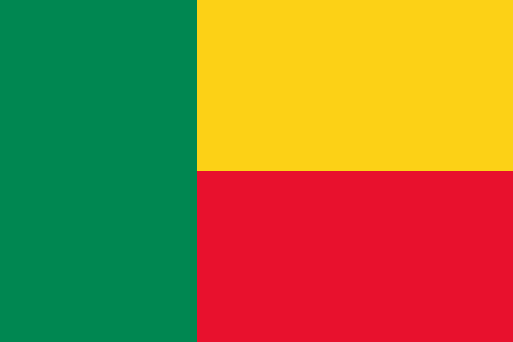
Photo by Élisée.Adad, CC BY-SA 4.0, via Wikimedia Commons
Overview
Benin, officially the Republic of Benin, formerly known as Dahomey, is a country in West Africa. It is bordered by Togo to the west, Nigeria to the east, Burkina Faso to the northwest, and Niger to the northeast. The majority of its population lives on the southern coastline of the Bight of Benin, part of the Gulf of Guinea in the northernmost tropical portion of the Atlantic Ocean. The capital is Porto-Novo, and the seat of government is in Cotonou, the most populous city and economic capital. Benin covers an area of 112,622 km2 (43,484 sq mi), and its population in 2026 was estimated to be approximately 15 million. It is a tropical country with an economy heavily dependent on agriculture and the exports of palm oil and cotton.
Text from Wikipedia, licensed CC BY-SA.
Where to go in Benin


Hidden gems
Lesser-known places that travellers on Wikivoyage recommend beyond the main cities of Benin: villages, national parks and quiet corners. The short descriptions come from those lists (CC BY-SA).

Pendjari National Park
No places listed yet
Pendjari National Park lies in north-western Benin, adjoining the Arli National Park in Burkina Faso. Named for the Pendjari River, the national park is known for its wildlife and is home to some of the last populations of big game like the African forest elephant, lion, hippopotamus, African buffalo, and various antelopes in West Africa. The park is also famous for its richness in birds.

W National Park
No places listed yet
The W National Park or W Regional Park is a major national park in West Africa around a meander in the Niger River shaped like the letter W. The park includes areas of the three countries Niger, Benin and Burkina Faso, and is governed by the three governments. Until 2008, the implementation of a regional management was supported by the EU-funded project ECOPAS. The three national parks operate under the name W Transborder Park. The section of W National Park lying in Benin, measuring over 8,000 km2 (3,100 sq mi), came under the full management of African Parks in June 2020. In Benin, W National Park is contiguous with Pendjari National Park which is also under the management of African Parks.
Public holidays
National days off in Benin in the next twelve months. Offices, banks and many shops close, and transport and stays get busier. Regional holidays and local festivals are not included, and holidays that follow the moon can move by a day.
- Christmas Day · Noël
- New Year's Day · Nouvel An
- Fête du Vodoun
- End of Ramadan (Eid al-Fitr) · Fête de fin du Ramadan
- Easter Monday · Lundi de Pâques
- Labour Day · Fête du travail
- Ascension Day · Ascension
- Feast of the Sacrifice (Eid al-Adha) · Fête du mouton
- Whit Monday · Lundi de Pentecôte
- Independence Day · Fête Nationale
- Birthday of Muhammad (Mawlid) · Mawlid
- Assumption · Assomption
- All Saints' Day · Toussaint
Dates from the date-holidays project, based largely on Wikipedia (CC BY-SA 3.0). Check locally before you plan around a holiday.
Travelling in Benin
Getting around the country
By bus. There is an extremely timely and reliable bus system that typically operates a tour-style bus through every major city in Benin every day, and even some international services in and out of Benin. There are many major lines with a range of quality of buses. The main systems are Confort Lines and Benin-Routes. Confort Lines seems to provide more of a variety of routes, and you even get some water and a little sandwich for long trips. Reservations for Confort Lines can be made in advance for CFA 500 at any regional office or by calling +229 21-325815. Bus lines run through: Porto-Novo, Cotonou, Calavey, Bohicon, Dassau, Parakou, Djougou, Natitingou, Tanguieta, Kandi, and even all the way up to Malanville. Buses run on the two major paved roads running north and south, and you can have the bus stopped at any point you would like to get off at, and for differing rates. No discussion of prices is needed with the bus, as they use fixed rates. To give you an idea of prices, buses running from Cotonou to Natitingou (or vice versa) cost CFA 7,500 one way, and Cotonou to Parakou (or vice versa) costs CFA 5,500. These are examples, because there are also buses that go as far as Tanguieta and Malanville.
By bush taxi. Bush taxi is possible between most cities, every day in major cities, periodically for the more remote ones. The price for long distances will be a little higher than by bus, and comfort and security are significantly lower.
Money and costs
Prices for goods purchased in a store, restaurant, hotel, bus tickets, etc. are non-negotiable, but almost everything else is. Depending on the item, it's not uncommon for foreigners to be quoted a price that is double the final purchase price. You can find any type of African commodity all over Benin.
Money. The currency of the country is the West African CFA franc, denoted CFA (ISO currency code: XOF). It's also used by seven other West African countries. It is interchangeable at par with the Central African CFA franc (XAF), which is used by six countries. Both currencies are fixed at a rate of 1 euro = 655.957 CFA francs. There are banks in all the major cities, and most of the banks have cash machines. Keep in mind that many businesses and offices, including banks, close for several hours in the middle of the day. MasterCard and Visa can be used to withdraw cash at the ATMs of Ecobank, Banque Atlantique, BIBE, and SGB.
Language
The official language is French — the language of the former colonial power. Native African languages such as Fon and Yoruba are spoken in the south, Bariba, Dendi and Hausa in the north, and over 50 other African languages and dialects are spoken in the country. English is on the rise.
Staying safe
The best way to stay safe in Benin is to always always always be in the presence of a local person whom you can trust, such as a friend or even a hired tourist guide. They know which areas are safe and which are not, they know the prices of things so you won't get ripped off, they speak the native languages, they know which venues sell good food that is safe for westerners to eat. For women, avoid travelling alone, try to be in the company of other people as much as possible. Do not travel at night alone: attacks along the beaches are frequent, and of course near hotels, nightclubs and other venues. Ignore any person who whistles at you during the night if you are alone. Benin is a peaceful country and the people are very kind and generous, but muggings and robberies occur everywhere, no matter how peaceful the place seems, so be on guard. If you are a victim of a crime, contact the Gendarme (Police) immediately.
LGBT travellers. Homosexuality in Benin is legal, which means that the police and government authorities are there to help you in case of need. LGBT events take place across the country, often discreetly. Occasional violence against LGBT people, especially trans people, is unfortunately present. There are many LGBT organisations in Benin, most notably Benin Synergies Plus (BESYP), Synergie Trans Benin, Hirondelle Benin.
From the Wikivoyage guide, written by travellers (CC BY-SA), shortened. For entry rules, visas, health and current safety, always check your government's official travel advice (linked above).