

Brunei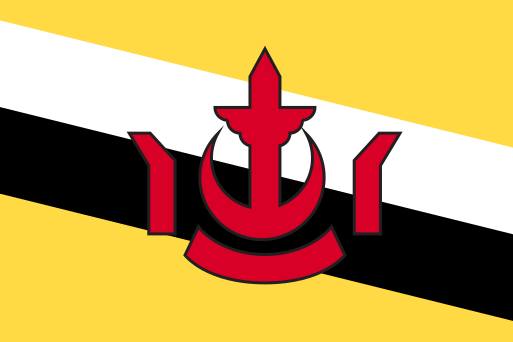
Photo by Balou46, CC BY-SA 3.0, via Wikimedia Commons
Overview
Brunei, officially Brunei Darussalam, is a country in Southeast Asia, situated on the northern coast of the island of Borneo. Apart from its coastline on the South China Sea, it is completely surrounded by the Malaysian state of Sarawak, with its territory bifurcated by the Sarawak district of Limbang. Brunei is the only sovereign state entirely on Borneo; the remainder of the island is divided between its multi-landmass neighbours of Malaysia and Indonesia. As of 2025, the country had a population of 466,330, being the least populated country in Asia of whom approximately 64,409 resided in the capital and largest city of Bandar Seri Begawan. Its official language is Malay, and Sunni Islam is the state religion of the country, although other religions are nominally tolerated.
Text from Wikipedia, licensed CC BY-SA.
Where to go in Brunei


Hidden gems
Lesser-known places that travellers on Wikivoyage recommend beyond the main cities of Brunei: villages, national parks and quiet corners. The short descriptions come from those lists (CC BY-SA).

Public holidays
National days off in Brunei in the next twelve months. Offices, banks and many shops close, and transport and stays get busier. Regional holidays and local festivals are not included, and holidays that follow the moon can move by a day.
- Christmas Day · Hari Krismas
- New Year's Day · Awal Tahun Masihi
- Laylat al-Mi'raj · Israk dan Mikraj
- Chinese New Year · Tahun Baru Cina
- First day of Ramadan · Awal Ramadan
- National Day · Hari Kebangsaan
- Nuzul Al-Quran · Hari Nuzul Al-Quran
- End of Ramadan (Eid al-Fitr) · Hari Raya Aidil Fitri
- Armed Forces Day · Hari Angkatan Bersenjata Diraja Brunei
- Feast of the Sacrifice (Eid al-Adha) · Hari Raya Haji
- Islamic New Year · Awal Muharram
- Sultan's Birthday · Hari Keputeraan KDYMM Sultan Brunei
- Birthday of Muhammad (Mawlid) · Hari Keputeraan Nabi Muhammad S.A.W.
Dates from the date-holidays project, based largely on Wikipedia (CC BY-SA 3.0). Check locally before you plan around a holiday.
Travelling in Brunei
Getting around the country
Use caution when asking locals for transportation information. People here are friendly and very helpful, but when asking about transportation, you'll get three different answers from three different people, even people whose job it is to help tourists.
By car. There is one "motorway", from Bandar Seri Begawan along the coast. It is almost all dual carriageway from Muara to Kuala Belait and the toll bridge to Malaysia/Sarawak in the west. There is also a side road off this, which runs into the jungle towards the settlement of Labi and beyond. Excellent scenery, and a 4-wheel drive may be useful, but the road is now sealed up to the longhouses some distance beyond Labi. Stock up on water at the convenient shop at the junction. Driving between Temburong and the rest of Brunei used to require passing through Malaysian territory, and clearing Malaysian customs and immigration, but since the completion of the Sultan Haji Omar 'Ali Saifuddien Bridge in 2020, that is no longer necessary.
By taxi. There are not many taxis in Brunei, because car ownership and usage are high. There are always some at the airport and some in the Belait District, but little chance of finding a free taxi along the road, especially during morning and afternoon peak hours when they are hired by businessmen. Needing a taxi might require a phone call. The main taxi stand is direct north of the bus station in the capital with only a few taxis waiting.
By ride-hailing. The main ride-hailing app in Brunei is Dart.
Money and costs
Money. The local currency is the Brunei dollar, denoted by the symbol "$" or "B$" (ISO code: BND). You might hear ringgit used to refer to the dollar but be sure that the speaker is not talking about the Malaysian Ringgit (MYR) which is valued at less than a third of a Brunei dollar. All prices in this guide are in Brunei dollars unless otherwise noted. The Brunei dollar is tied to the Singapore dollar at a 1:1 rate. By law the currencies can be used interchangeably, so if you're coming in from Singapore, there's no reason to change money as your cash will be readily accepted. (Likewise, any leftover Brunei dollars can be used at par in Singapore.) However, many stores refuse Singapore notes with seemingly microscopic tears, stains or markings on them, and notices to this effect are posted at the cash register. Malaysian ringgit (RM) are also be accepted in a pinch, at an unfavourable exchange rate. The ringgit is not available at Brunei banks but can be obtained from money changers. The Brunei dollar is divided into 100 cents. There are banknotes from $1 to a whopping $10,000 (handy if you're shopping for Rolls-Royces), and coins of 1 to 50 cents. All smaller notes and the 2004 series of larger notes are printed as brightly coloured polymer notes.
Costs. By Southeast Asian standards Brunei is roughly on par with Singapore, meaning roughly twice as expensive as neighbouring Malaysia. You can reduce costs by eating at local restaurants and avoiding the more expensive restaurants in hotels.
Language
The official language of Brunei is Malay (Bahasa Melayu), but due to its British colonial past, English is widely spoken and understood in urban areas, though sometimes with a thick accent. A little Malay will come in handy in rural areas, as English proficiency is limited there. While all Bruneians are able to speak standard Malay, the local dialect of Malay has some ideosyncrasies that can make it tricky to understand if you only just started learning Malay. Brunei also officially uses the Arabic script for Malay known as Jawi. Outside of government signage and religious publications almost all signs use the Roman alphabet. The ethnic Chinese community in Brunei continues to speak a variety of Chinese languages, including Hokkien, Teochew, and several others.
Customs and manners
The Brunei Government is run as a Malay Islamic Monarchy (Melayu Islam Beraja) principle, which means that the Sultan of Brunei, apart from being one of the richest men in the world, effectively runs the country. You can expect the Sultan to appear on the front page of the two local daily newspapers almost every day, and occupy the first ten minutes of the local TV news bulletins. You'll see the wealth of the country in everything that the Sultan touches, but much of the rest of the country misses out on badly needed investment and development. Over half of the country are expatriate workers or permanent residents, and it's not hard to engage them in a conversation about the political situation once you gain their trust. Brunei is a country where your race, religion and heritage matter in day-to-day life. Still, it's best to approach the subject very carefully, especially with Bruneians. The Bruneian Royal Family is protected by lèse-majesté laws; speaking out against them or making fun of them is a crime and will result in a prison sentence. Bruneians are generally courteous and tolerant. Non-Muslims are generally not expected to comply with Islamic dress codes. Women can wear sleeveless shirts and shorts and blend in, and are not legally required to wear the hijab, known locally as the tudung. Super-skimpy swimming attire is certainly a step too far.
Phones and internet
By phone. The international code for Brunei is 673. The telephone numbers in Brunei consist of 7 digits with no local codes, although the first digit of the number indicates the area such as 3 for the Belait District and 2 for Bandar Seri Begawan. The prepaid Hallo Kad, available from TelBru telephone offices (including one at the airport) and other outlets in denominations from $5-50 can be used at any phone in the country to make local and international calls. Other phone cards are also available for use in public phones. Mobile phone services are provided by three network operators: state-owned DST, Progresif (best 5G coverage) and Imagine (4G LTE only, least coverage). Coverage is available across almost all of the country. Coverage in the Temburong national park may be patchy.
Staying safe
Brunei is a very safe country, with low crime rates and no major security concerns. Brunei has a strict legal system ― which combines British common law and Sharia law ― that punishes crime severely, adding a huge layer of deterrence. The full harshness of Brunei's laws is reserved for criminals and those actually looking for trouble. Brunei, like Malaysia, Indonesia and Singapore, has very strict laws when it comes to drugs. Drug trafficking to a certain degree has a mandatory death sentence. Other crimes, such as murder, kidnapping and unauthorised possession of firearms are also punished with death. While an informal moratorium of capital punishment exists, offenders should still expect life imprisonment or a long prison term. Brunei uses caning (for males only) for rapes, as well as for less serious crimes, including illegal entry, overstaying your visa for over 90 days, robbery, corruption and vandalism. Caning is no slap on the wrist. Strokes from the thick rattan cane are excruciating. They can take weeks to heal, and even scar for life. These laws apply to foreigners as well. In theory, offences such as rape, adultery, sodomy, robbery and insult or defamation of the Prophet Muhammad carry the maximum penalty of death, though this is not enforced. Homosexuality carries a penalty of 40 strokes of the cane and/or a maximum of 10 years in jail. The punishment for theft that exceeds a certain amount is amputation.
From the Wikivoyage guide, written by travellers (CC BY-SA), shortened. For entry rules, visas, health and current safety, always check your government's official travel advice (linked above).