

Burundi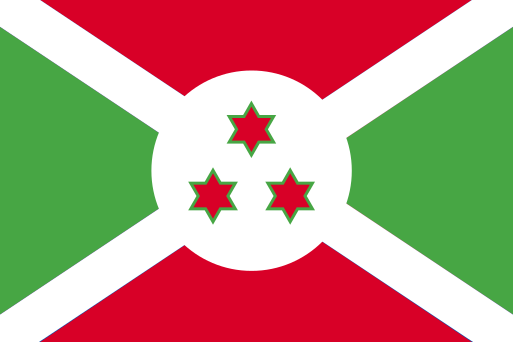
Photo by NIHEREWENIMANA Richard, CC BY-SA 4.0, via Wikimedia Commons
Overview
Burundi, officially the Republic of Burundi, is a landlocked country in East Africa. It is located in the Great Rift Valley at the junction between the African Great Lakes region and southeastern Africa, with a population of over 14 million people. It is bordered by Rwanda to the north, Tanzania to the east and southeast, and the Democratic Republic of the Congo to the west; Lake Tanganyika lies along its southwestern border. The political capital city is Gitega and the economic capital and largest city is Bujumbura.
Text from Wikipedia, licensed CC BY-SA.
Where to go in Burundi


Hidden gems
Lesser-known places that travellers on Wikivoyage recommend beyond the main cities of Burundi: villages, national parks and quiet corners. The short descriptions come from those lists (CC BY-SA).

Bururi Forest Natural Reserve
No places listed yet
The Natural reserve of Bururi is a 3300 ha expanse of altitude damp forest. The town of Bururi offers visitors this wonderful panorama, to visit the park first go to the INECN office in Bururi, it's not common knowledge among Bururians that you have to do this first. If you are told that there is no entry fee and no guides are available, this is not true. At the office you can pay the entry fee (FBu5,000) and arrange a guide FBu5,000. In this place there are about 117 species of birds and 25 species of mammals have been identified in a forestland surrounding of multifarious vegetation. On a walking circuit along the botanical lanes and trails of this forest the visitor will fully enjoy the wild coolness of our mountains densely covered with trees of many different species. This region is 33 km from Roumonge. The road through it will drive you from the lakes along miles of hallucinating and breathtaking panoramas.

Kibira National Park
No places listed yet
At the apex of the Zaire-Nile, with its 40,000 ha of preserved forests, this the largest completely untouched natural area in Burundi. Its wild life constitutes a shelter for chimpanzees, baboons, cercophitecus (a monkey) and black colobes scattering away to the approach of human beings. The park is criss-crossed by a network of 180 km of tracks and paths mainly used by guard car patrols and motorized tourists. The guards of the park will scout you in the wood undercover where you will be able to discover the fascinating attraction of the primeval forest and the charming songs of birds. Mountain chains hide thermal springs, and the access to the park is made through the tea plantations of Teza and Rwegura which count among the best natural sceneries.

Rusizi National Park
No places listed yet
Home to Gustave, the infamous man-eating crocodile, Rusizi National Park will be your first visit in Burundi for the simple reason that it is very near the capital city of Bujumbura. The River Delta extends over 500 ha of vegetation made of Phragmites mauritianus. It is a natural shelter for few families of antelopes and hippopotamuses that come here in quest of grazing land. At the end of the track if you are lucky enough you may meet with a few crocodiles fast asleep on the golden sand of the river banks. The Rusizi palm groves (situated on the Cibitoke road 10 km away from Bujumbura) is also an exceptional landscape that will no doubt make your mind drift away from your day to day preoccupations. It offers to the visitor a rich vegetation completely adapted environment gratified by only a few sparse rains, made of euphorbia, thorny bushes and tall palm trees of the Hyphaena bengalensis var ventricosa species. Right in the deepest part of the reserve you will be able to admire the natural ponds left by the Rusizi meanders. This place is a paradise for birds which come by the hundred and feed themselves by dive-fishing. If you are patient enough you will be able to see some hippopotamuses paddling in the shallow waters.
Public holidays
National days off in Burundi in the next twelve months. Offices, banks and many shops close, and transport and stays get busier. Regional holidays and local festivals are not included, and holidays that follow the moon can move by a day.
- Christmas Day · Noël
- New Year's Day · Nouvel An
- Unity Day · Jour de l'Unité
- End of Ramadan (Eid al-Fitr) · Fête de fin du Ramadan
- Ntaryamira Day · Jour de Ntaryamira
- Labour Day · Fête du travail
- Ascension Day · Ascension
- Feast of the Sacrifice (Eid al-Adha) · Fête du mouton
- Independence Day · Jour de l’Indépendance
- Assumption · Assomption
- Rwagasore Day · Jour de Rwagasore
- Ndadaye Day · Jour de Ndadaye
- All Saints' Day · Toussaint
Dates from the date-holidays project, based largely on Wikipedia (CC BY-SA 3.0). Check locally before you plan around a holiday.
Travelling in Burundi
Getting around the country
Road and water transport are the main ways for getting around. There are no railways in the country, and the airport in Bujumbura is the only one with scheduled flights (all international).
By bus. There are buses between Bujumbura and other cities in the country.
By taxi. Taxi is an option for intercity travel as well. For example a roundtrip between Bujumbura and Gitega by taxi would cost you around $50 including the fuel.
By car. Traffic culture is moderate, but motorists should be careful. Beware of pedestrians walking in the middle of the road, don't be afraid to use the horn. Moreover local drivers, particularly taxi and van drivers ignore traffic rules all too often. In Bujumbura, traffic can be very confusing at times and the rural roads are narrow and winding due to the hilly terrain. Roads are of decent quality. Major roads are paved. The roads along the shores of Lake Tanganyika are dangerous; they are in poor condition and are not fenced off at the steepest points.
Money and costs
Money. The currency is the Burundian franc, denoted by the symbol "FBu" (ISO code: BIF). Banknotes in Burundi are issued in denominations of 50, 100, 500, 1,000, 2,000, 5,000 and 10,000 francs. DTB bank, Ecobank, CRDB, and KCB have ATMs in Burundi where you can get a cash withdrawal with Visa Card or MasterCard. The Ecobank website has a full list of locations.
Shopping. Burundi is endowed with very flourishing craftsmanship, with unique delicate and attractive shapes. The visitor will be able to find Gitega and Bujumbura talented artist able to carve sceneries on wooden boards and paint landscapes with beautifully shaded bluish backgrounds.
Language
Although most travellers will find that they can get around passingly well with a working knowledge of French and increasingly English, some familiarity with Swahili or the related local language, Kirundi, is helpful, particularly in rural areas. The problem may be that Kirundi is extremely difficult to learn. Kirundi and Kinyarwanda (the official language in Rwanda) are quite similar.
Customs and manners
As is the case in all African countries, Burundi is a hierarchial society, which means that respect for elders is important. Always treat an older person/authority figure with a great degree of respect, and do not do anything that would make an older person/authority figure feel challenged. Burundians are family-oriented. It's common for Burundian parents to be intimiately involved in the lives of their children, and they aim to school their children in proper behavior, communal values, and family values. Passing unwarranted comments and/or criticisms about someone's family members is considered rude. If you've been invited to a Burundian home, you may be showered with snacks and drinks. Do not reject any of these; it's considered rude manners to do so and it could get your host(s) to think that you do not appreciate their hospitality.
Staying safe
Although some semblance of normality has returned to much of the country with the conclusion of the nation's democratic transition and a democratically chosen head of state in 2005, there is still significant insecurity throughout the country and travellers should exercise extreme caution. Besides the still-active rebel group, the Forces Nationales de la Libération (FNL) that continues to attack government forces and civilians, threats posed by banditry and armed robbery, as well as petty crimes, remain. Visitors should exercise caution, avoid travelling after dark, and be aware of curfew laws. Many roads close at night, and most embassies put out curfews on their staff. As in any other conflict or post-conflict situation, visitors should consult their embassy to be apprised of the latest local developments, and be sensitive to the changing security environment.
From the Wikivoyage guide, written by travellers (CC BY-SA), shortened. For entry rules, visas, health and current safety, always check your government's official travel advice (linked above).