

Cape Verde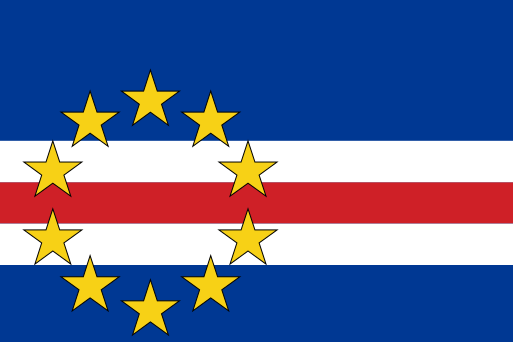
Photo by Xandu, Public domain, via Wikimedia Commons
Overview
Cape Verde, also referred to in English by its Portuguese name Cabo Verde, and known officially as the Republic of Cabo Verde, is an archipelagic country in the eastern Atlantic Ocean, off the coast of West Africa. It consists of ten volcanic islands with a combined land area of about 4,033 square kilometres (1,557 sq mi). These islands lie between 600 and 850 kilometres west of Cap-Vert, the westernmost point of continental Africa, after which they are named. Cape Verde forms part of the Macaronesia ecoregion, along with the Azores, the Canary Islands, Madeira and the Savage Islands.
Text from Wikipedia, licensed CC BY-SA.
Where to go in Cape Verde


Public holidays
National days off in Cape Verde in the next twelve months. Offices, banks and many shops close, and transport and stays get busier. Regional holidays and local festivals are not included, and holidays that follow the moon can move by a day.
- Christmas Day · Natal
- New Year's Day · Ano Novo
- Democracy Day · Dia da Democracia
- Heroes' Day · Dia dos Heróis Nacionais
- Shrove Tuesday · Carnaval
- Ash Wednesday · Quarta-feira de Cinzas
- Good Friday · Sexta-Feira Santa
- Labour Day · Dia do trabalhador
- Children's Day · Dia das Crianças
- Independence Day · Dia da Independência
- Assumption · Dia da Padroeira Nacional
- National Day · Dia Nacional
- All Saints' Day · Todos os santos
Dates from the date-holidays project, based largely on Wikipedia (CC BY-SA 3.0). Check locally before you plan around a holiday.
Travelling in Cape Verde
Getting around the country
Most road and sidewalk surfaces in Cabo Verde are made of large, rough, irregular, uneven and sharp cobblestones, which are often spaced wide apart and may protrude several centimetres from the ground. These surfaces are generally unsuitable for wheeled luggage, baby strollers, folding bicycles or anything with wheels smaller than those of a car or standard bicycle. Transportation between islands is possible by plane and ferry. Plane tickets are more expensive than ferry tickets. If funds are not a constraint, Cabo Verdeans seem to prefer flights due to better reliability, shorter duration and lack of sea-sickness. Timetables in Cape Verde are not to be taken too seriously - don't be too surprised if that boat departs ahead of schedule or if that flight suddenly gets postponed until tomorrow. This is important to consider if you decide to do some island-hopping. Due to weather and other conditions flights may be delayed or canceled. Carry your toothbrush with you and build in some buffer time to your planning especially if you need to meet an international connection.
By plane. As of April 2026, CV Sky has regular daily flights between the majority of the islands. Booking is possible through the website or local tourist agencies. Payments can be made via Credit Card when selecting the vinti4 payment options. Tickets may be sold out days or weeks ahead - especially if there are more potential passengers when the ferry service is interrupted.
By ferry. There are ferry services between the islands.
Money and costs
Money. ]] The official currency of Cape Verde is the escudo, denoted by the symbol "" (a cifrão, a symbol similar to the dollar sign, but with two vertical strokes instead of one) after the amount. Its ISO code is CVE. The currency is fixed against the euro at 110 per euro. Coins in Cape Verde are issued in denominations of 1-, 5-, 10-, 20-, 50-, 100-, 200-, 250 and 500 escudos. Banknotes in Cape Verde are issued in denominations of 200-, 500-, 1,000-, 2,000 and 5,000 escudos. In the resort islands of Sal and Boa Vista, euros are commonly accepted, although you might receive change in escudos. Money can be changed from all major currencies at the international airports at Sal and Praia. Bank branches at larger towns will also change money. Larger towns also have ATMs that will take Visa, MasterCard and Maestro. High-end hotels will accept credit/debit cards. Other hotels will expect cash although many mid-range ones will accept euros at a reasonably exchange rate (slightly worse than the banks). For everything else, expect to pay in escudos.
Costs. Since most goods are imported, the cost of living is moderate to high. On the island resorts of Boa Vista and Sal, the cost of living can often be compared to their Caribbean counterparts. The island of Santiago is reasonably the least expensive.
Language
The official language is Portuguese, used in all official publications and announcements as well as in business, media and schools, but the local language is Cape Verdean Creole (Kriolu kabuverdianu), a Portuguese-based creole language with 90-95% of the words from Portuguese and the rest mainly from West African languages. It is divided into 9 dialects spoken on various parts of the country. Even though Kriolu is comprehensible to a skilled Portuguese-speaker, almost all people can also speak Portuguese as a second language. A considerable number of Cape Verdeans also speak English; basically, Kriolu is your first option, Portuguese second, English third.
Customs and manners
People are polite and friendly. It is good to buy something, but important to bargain.
Phones and internet
The telephone system is effective and improving. The country also has one Internet service provider.
Mobile connectivity. There is mobile phone coverage in all cities and most towns. As of July 2022, 4G coverage is common in some populated areas such as Santiago and Fogo. Check with your provider as to the roaming costs. Alternatively, local prepaid SIM cards branded CVMovel and Unitel T+ (Tmais) are available widespread. As of July 2022, these can be charged with around $1000 for approximately 7 GB of data, unlimited calls into the same provider network and 15 minutes of calls into the other provider. Ask the personnel to activate the SIM card for you and to activate the prepaid tariffs.
Staying safe
Pickpocketing and purse snatching are quite common in Cape Verde, especially in the main cities (Praia, Mindelo) and on the islands popular with tourists (Boa Vista, Sal). Thieves should be particularly watched out for in large crowds, such as at markets, festivals or other celebrations. Theft and robbery are often committed by street children and youth gangs. Violent crime, much of it drug-related, has also increased. It is best to avoid travelling alone at night. There are also cases of robberies against tourists on beaches. The emergency number is 132. UK health authorities have classified Cape Verde as having a risk of Zika virus transmission. The WHO declared that, as of 2024, malaria has been eradicated in the entire country, with no cases reported for over three years.
From the Wikivoyage guide, written by travellers (CC BY-SA), shortened. For entry rules, visas, health and current safety, always check your government's official travel advice (linked above).