

Guyana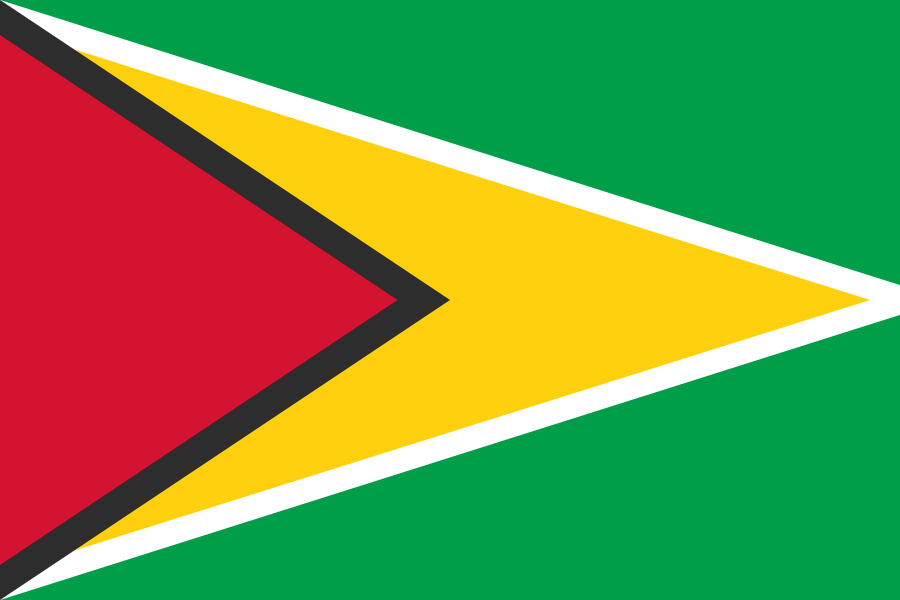
Photo by David Stanley, CC BY 2.0, via Wikimedia Commons
Overview
Guyana, officially the Co-operative Republic of Guyana, is a country on the northern coast of South America. It is bordered by the Atlantic Ocean to the north, Suriname to the east, Brazil to the south and southwest, and Venezuela to the west. It is part of the Guianas. The capital and largest city is Georgetown.
Text from Wikipedia, licensed CC BY-SA.
Where to go in Guyana


Hidden gems
Lesser-known places that travellers on Wikivoyage recommend beyond the main cities of Guyana: villages, national parks and quiet corners. The short descriptions come from those lists (CC BY-SA).

Public holidays
National days off in Guyana in the next twelve months. Offices, banks and many shops close, and transport and stays get busier. Regional holidays and local festivals are not included, and holidays that follow the moon can move by a day.
- Christmas Day
- Boxing Day
- New Year's Day
- Republic Day
- Good Friday
- Easter Monday
- Labour Day
- Arrival Day
- Eid Ul Adha
- Independence Day
- CARICOM Day
- Emancipation Day
- Youman Nabi
Dates from the date-holidays project, based largely on Wikipedia (CC BY-SA 3.0). Check locally before you plan around a holiday.
Travelling in Guyana
Getting around the country
When people in Guyana refer to buses, they mean minibuses. Minibuses travel throughout Guyana and are the cheapest way to travel. Minibus fares range from G$60-1,000 depending on the length of the journey. Travel in this mode at night could be risky. Many parts of Guyana are separated by large rivers. These areas can be traversed by way of river taxi. Go to the port village and ask from where the speedboats launch. Ask other passengers what the fare is while travelling as boat operators tend to seek higher fees from tourists. Do not take "specials" without first negotiating the price. Taxis are a good way to get around in Georgetown. Fares should never be more than G$500 for travel within the city and most fares should be around G$400. All taxi number plates begin with 'H.' There are set prices for taxis for different destinations, e.g. from the airport to town costs G$5,000, from the airport to Moleson Creek is G$24,000. From Ogle to downtown is G$1,500. One can also rent cars or 4x4s; check the local telephone listings for car rentals. Consult more than one rental agency as prices can vary. You might also be able to negotiate the prices charged to some extent. Deposits are usually required. If renting a vehicle, be sure to inquire whether your driver's licence will be acceptable. Violations of traffic laws can result in much time wasted and possible trips to the local courts.
Money and costs
There are numerous markets and shopping malls, in Guyana. Stabroek Market is a quaint market in Georgetown. Trips to the market for tourists are best done in groups or with a local with whom you feel comfortable. Muggings are possible but not frequent. Lots of locally made and beautiful crafts ranging from paintings; to sculpture; to leather purses, satchels, wallets; hand-painted, tie-dyed and batiked fabrics, pressed flowers, sun hats; semi-precious stones and hand-crafted costume jewellery using indigenous materials, can be purchased at an esplanade outside the Central Post-Office near the National Museum in downtown Georgetown. Ask around and you'll find out about the craft and gift shops as well as galleries. Guyana is also noted for its exceptional gold jewellery.
Money. The local currency is the Guyanese dollar, denoted $ or G$ (ISO international currency code: GYD). The currency is freely convertible but nearly impossible to get rid of outside of Guyana, the neighbouring countries and one exchange bureau in London Gatwick airport. Banknotes in Guyana are issued in denominations of G$20, G$50, G$100, G$500, G$1,000, G$2,000 and 5,000 and coins in Guyana are issued in denominations of G$1, G$5 and G$10. G$500, G$1,000 and G$5,000 banknotes have a holographic stripe with a colourful macaw. Scotiabank and Republic bank take MasterCards at their ATMs.
Language
The only official language is English (with British spelling) and is spoken by all, though most people natively speak Guyanese Creole. The English spoken has a typical Caribbean accent and foreigners unfamiliar with the accent may find it hard to understand. There are a handful of Amerindian languages spoken in the Amazonian region, most notably Arawak and Macushi.
Customs and manners
Guyanese people do not wear shoes in their homes and expect visitors to do the same. Discussions of the current affairs of ethnic relations between the two major races, politics and the socio-economic issues in the country ought to be undertaken with much tact and much patience. These types of discourses can sometimes lead to very heated and intense debate, and possibly something much worse. Guyanese are generally very open to discussing most issues, but as an outsider, you could be seen as a part of the problem, so guard your tongue.
Phones and internet
Police +592 226 2487 emergency - 911 Fire +592 226 2411 emergency - 912 Ambulance Service emergency - 913 Cheddi Jagan International Airport +592 261 2245 Ministry of Foreign Affairs +592 226 1606 Ministry of Tourism Industry & Commerce +592 226 2392 Guyana Telephone & Telegraph +592 225 1315 Licence Revenue Office +592 223 5501
Staying safe
in the south of the country]] Georgetown is notorious for petty street crime. Do not walk alone at night, or even in the day, unless you know the area well. Areas such as the Tiger Bay area east of Main Street and the entire southeastern part of the city including Albouystown and Ruimveldt are traditional high crime areas but one can be relatively safe in groups and with native escorts. Police are unlikely to help you unless they see the crime in action. Be sensible about wearing jewellery. The interior regions with the breath-taking waterfalls, the beautiful rainforests and mountains are safe. Many rural areas around the country are filled with a friendly atmosphere and are safe. Crime is rarely directed at tourists, so don't feel intimidated. Just be sensible about the company you keep, where you go and how you behave. "Sodomy" is punishable with a maximum sentence of life in prison. A local NGO reported that there were a few prosecutions, but neither the NGO nor the courts could provide numbers. It was reportedly more common for the police to use the law to intimidate suspected same-sex male partners. There are no laws concerning same-sex sexual activity between women.
From the Wikivoyage guide, written by travellers (CC BY-SA), shortened. For entry rules, visas, health and current safety, always check your government's official travel advice (linked above).