

Uruguay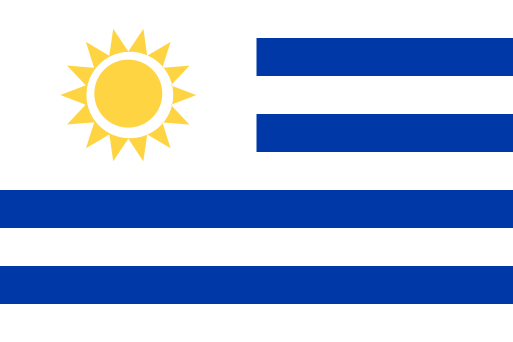
Photo by Eduardo Ruggieri, CC BY-SA 3.0, via Wikimedia Commons
Overview
Uruguay, officially the Oriental Republic of Uruguay, is a country in southeastern South America. It shares borders with Argentina to its west and southwest and Brazil to its north and northeast, while bordering the Río de la Plata to the south and the Atlantic Ocean to the southeast. It is part of the Southern Cone region of South America. Uruguay covers an area of approximately 176,215 square kilometers (68,037 sq mi). It has a population of almost 3.5 million people, of whom nearly 2 million live in the metropolitan area of its capital and largest city, Montevideo.
Text from Wikipedia, licensed CC BY-SA.
Where to go in Uruguay


Hidden gems
Lesser-known places that travellers on Wikivoyage recommend beyond the main cities of Uruguay: villages, national parks and quiet corners. The short descriptions come from those lists (CC BY-SA).

Cabo Polonio
4 places listed
Cabo Polonio is a hamlet located in the eastern coast of Uruguay in the Rocha Department. It is located in one of the country's SNAP areas and is notable for its natural features. According to the 2023 census, it had a population of 128, but its population swells during the summer when it receives thousands of tourists.

Barra de Valizas
3 places listed
Barra de Valizas, also known as simply Valizas, is a resort (balneario) in the Rocha Department of southeastern Uruguay.

Piriapolis
3 places listed
Piriápolis is a city in the Maldonado Department of Uruguay. It is an important summer resort in the country, predating the larger and better known resort town of Punta del Este. Because it is mainly used as a resort, it has a relatively small permanent population for a city of its size.

Anchorena National Park
No places listed yet
Official presidential retreat and protected area of native forest and landscaped areas with native and exotic plants and wildlife

Esteros de Farrapos
No places listed yet
A national park and a protected Ramasar wetland of international significance. It is considered the best spot in Uruguay to observe wild animals. Gateway to the park is the town of Nuevo Berlín.

Laguna de Rocha
No places listed yet
Protected lagoon that is a breeding ground for over 200 species of bird, the national park includes the entire lagoon, surrounding grasslands and forest, and a barrier island with occasional channels to the open sea

Santa Teresa National Park
No places listed yet
Including the colonial fortress Fortaleza de Santa Teresa
Central Interior
35 places listed
Punta del Diablo
22 places listed
Punta del Diablo is a village and seaside locality in Uruguay, Rocha Department, 298 kilometres (185 mi) east from the capital Montevideo. According to the 2011 census, its permanent population consisted of 823 inhabitants, mostly fishermen and artisans, while during high tourism season, the population swells to approximately 25,000, mostly with Argentinians, Brazilians and Europeans on holiday. As with the country it is located in, the primary language spoken in Punta del Diablo is Spanish. In 2008 it was named by the magazine "Lonely Planet" as one of the top 20 places to visit and invest.
Atlantic Coast
16 places listed
In addition to the major beach towns mentioned above, there are some quieter spots worth a visit:
Trinidad
4 places listed
A natural formation of caves 46 km from Trinidad and recognized by UNESCO.
San Miguel National Park
2 places listed
Historic Spanish colonial coastal defense fortress, natural areas include beach, grasslands, and forest
Quebrada de los Cuervos
No places listed yet
"Ravens' Gorge", a protected landscape of rolling hills and a deep gorge
Public holidays
National days off in Uruguay in the next twelve months. Offices, banks and many shops close, and transport and stays get busier. Regional holidays and local festivals are not included, and holidays that follow the moon can move by a day.
- Christmas Day · Navidad
- New Year's Day · Año Nuevo
- Maundy Thursday · Jueves Santo
- Good Friday · Viernes Santo
- Labour Day · Día del Trabajador
- Constitution Day · Día de la Constitución
- Independence Day · Día de la Independencia
Dates from the date-holidays project, based largely on Wikipedia (CC BY-SA 3.0). Check locally before you plan around a holiday.
Travelling in Uruguay
Getting around the country
By train. There are limited commuter train services around Montevideo, provided by the Administración de Ferrocarriles del Estado. As of Jan 2025, the commuter train is inactive due modernization of the tracks. There are some tourist trains which do not have a fixed schedule. You need to find announcements for them at the Montevideo train station, located at the corner of Nicaragua and Paraguay. There is, except a slow train connection between Taucarembó and Rivera in the far north, no regular long distance train service. The most usual means of public transport is the bus (local buses inside Montevideo and from Montevideo to other main cities of the country).
By bus. Uruguay has an extensive internal bus system, in practice the only way of getting around between cities if you aren't driving. From Montevideo interdepartmental buses leave from the Tres Cruces station which also serves the international buses. There are often several companies serving the routes and the buses are frequent, safe, comfortable and affordable. Buses generally depart right on time. Depending on the company, tickets can usually be bought online, at bus stations and on board the buses themselves. If you buy tickets before departure you will get a reserved seat, otherwise you can sit at seats that don't happen to be occupied (otherwise there's place to stand in the aisle). Usually, there is a separate inspector on board selling and checking tickets.
By taxi. Taxis in Uruguay are safe and fairly affordable, costing about US per km.
Money and costs
Money. The Uruguayan currency is the peso (ISO code: UYU). Prices are quoted using the U$ symbol, which may be easily confused with the US dollar symbol. Prices on costlier goods and services (over US$100, generally speaking) are often quoted in American dollars instead of pesos, and US dollars are surprisingly widely accepted even at some fast food restaurants. Places that cater to foreign visitors often also accept Argentinian pesos or Brazilian reals. All of these currencies use the symbol "$", so check which currency the prices are in if you're unsure. Coins in Uruguay come in denominations of 1, 2, 5 and 10 pesos Uruguayos. Banknotes in Uruguay come in denominations of 20, 50, 100, 200, 500, 1,000 and 2,000 pesos Uruguayos.
Cash, ATMs and credit/debit cards. Credit/debit cards are not as widely accepted as in North America or Europe - smaller establishments often accept only cash (efectivo). Try to have more or less exact change as they even in a mid-size supermarket can have some problems giving you change back if you are paying for U$600 worth of purchases with a U$1000 bill. You can exchange a large bill for smaller change without paying a commission at Abitab, a one-stop shop with branches all over Uruguay that offers all kinds of services, including paying bills, buying tickets for performances, and adding money to transit cards. Many Uruguayan ATMs can dispense US dollars in addition to pesos. You can find ATMs by looking for signs saying "BanRed" or "RedBrou".
Language
Spanish is the country's official and national language. The pronunciation and the use of the vos pronoun instead of tú is practically the same as the Spanish variety spoken in Argentina, also known as Rioplatense Spanish. However it is remarkably different from the Spanish spoken in Spain when it comes to pronunciation, grammar and vocabulary. If you are not familiar with the local dialect, be prepared to regularly having to ask people you're talking with to repeat themselves. Although most Uruguayans have studied English at school, they do not actually speak or use it. However, some Uruguayans have studied English at private institutes, so they can speak it well. Outside Montevideo, Colonia and Punta del Este, there are few English speakers.
Customs and manners
Uruguay is a socially progressive country. Women got the vote in Uruguay 12 years before France. Uruguay is a secular state unlike Argentina, Chile or Paraguay; the Uruguayan state has not supported any religion since 1917. Even national holidays are officially referred to with secular names—the week before Easter is officially "Tourism Week" and December 25th is "Family Day"! The population is mainly Catholic, but not very practicing. Uruguay is considered to be safe and welcoming to gay and lesbian visitors: it is ranked 12th in the world in the Spartacus Gay Travel Index. It was the first Latin American country to pass a civil union law, and same-sex marriage was legalized in mid-2013. Even in rural areas, gay travelers experience little overt discrimination. There are a few gay and lesbian bars in Montevideo and in Punta del Este. The only public monument to sexual diversity is in Ciudad Vieja (the old city) in Montevideo. On the last Friday of September, Montevideo celebrates "Diversity Month" with a parade on 18 of July in the center of the city. Like in other Latin American countries, it's common to greet people with a kiss on the cheek. But unlike most other countries, where this is only done between two women or between a woman and a man, in Uruguay it's not uncommon for men to greet each other this way too!
Body language. The "OK" sign (thumb and index finger in a circle) is an exceptionally offensive gesture. Do not exhibit it. A thumbs up is okay and not offensive.
Phones and internet
Telephone. The national landline telephone monopoly is Antel, which provides all public pay phones and is also the sole provider of landline Internet service. Although Antel pay phones only take Antel's proprietary magnetic cards (that are difficult if not impossible to obtain), it is possible to use international calling cards to call home by taking the phone off the hook, waiting for a dial tone, and dialing the correct access code. However, note that many public pay phones are not properly maintained. If you do not hear a touch tone emitted for each key, that means the phone is defective and you must try another one. Uruguay's country code is +598. Montevideo and suburbs have landline numbers beginning in 2, while the rest of the country has landline numbers beginning with 4.
Cell phone. Antel also operates a cell phone network, and competes with two private companies, Movistar and Claro. All three have numerous kiosks and stores throughout the country. Both the European (1800 MHz) and North American (1900 MHz) frequencies are used.
Mail. The national postal service is Correo Uruguayo. Most of their post offices are very hard to find and are open M-F 09:00-17:00; some are open Sa 09:00-12:00.
Staying safe
Historically, Uruguay used to enjoy a low rate of violent crime compared to some of its neighbors. However, this does not mean that Uruguay is crime free. The major differences are that most Uruguayan crimes are either nonconfrontational or do not involve the gratuitous use of firearms. Montevideo in particular has seen its crime rate gradually rise since the severe 2001-2002 financial crisis, and now has moderately high levels of theft, burglary, and robbery similar to those found in major U.S. cities. Fortunately, Punta del Este and most rural areas continue to enjoy relatively low crime levels. In Montevideo, take precautions: use a money belt and/or hotel safe for valuables, look alert, keep out of obvious slums, and avoid wandering around unfamiliar or iffy neighborhoods at night. In a security emergency, call 911 or 999. For firefighters, call, 104. For ambulance, call 105. Cannabis is one of the most widely used drugs in the country and legal as well. Uruguay is the first country in the world where the sale, growth and distribution of cannabis is legal. Regarding the legality of marijuana, possession for personal use is not penalized if it concerns minor quantities (a few grams), either Uruguayan or foreign. Possession of major quantities (for example, one kilogram) is illegal and punishable by law.
Natural disasters. Uruguay is vulnerable to floods. If it rains too much, roads can become impassable and riverside houses may need to be evacuated.
From the Wikivoyage guide, written by travellers (CC BY-SA), shortened. For entry rules, visas, health and current safety, always check your government's official travel advice (linked above).