

Belarus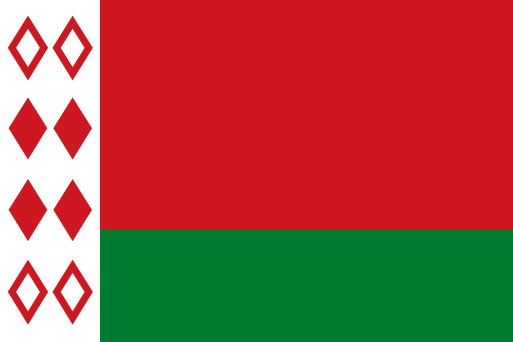
Photo by Zedlik, CC BY-SA 3.0, via Wikimedia Commons
Overview
Belarus, officially the Republic of Belarus, is a landlocked country in Eastern Europe. It is bordered by Russia to the east and northeast, Ukraine to the south, Poland to the west, and Lithuania and Latvia to the northwest. Belarus spans an area of 207,600 square kilometres (80,200 sq mi) with a population of 9.1 million. The country has a hemiboreal climate and is administratively divided into six regions. Minsk is the capital and largest city; it is administered separately as a city with special status.
Text from Wikipedia, licensed CC BY-SA.
Where to go in Belarus


Hidden gems
Lesser-known places that travellers on Wikivoyage recommend beyond the main cities of Belarus: villages, national parks and quiet corners. The short descriptions come from those lists (CC BY-SA).

Mir
3 places listed
Mir is an urban-type settlement in Karelichy District, Grodno Region, Belarus. It is situated on the banks of Miranka River, about 85 kilometres (53 mi) southwest of the capital, Minsk. As of 2025, it has a population of 2,248.

Narachansky National Park
3 places listed
A natural woodland reserve with lots of lakes in the northern part of the region

Haĺšany
2 places listed
A village with a ruined castle and a Baroque monastery, once a seat of a princely Holszanski family.

Pripyatsky National Park
1 place listed
A natural reserve in the region of Polesia, a swampy and woodland area in the southern part of Belarus

Belovezhskaya Pushcha National Park
No places listed yet
On the border with Poland, this primeval forest is a
Public holidays
National days off in Belarus in the next twelve months. Offices, banks and many shops close, and transport and stays get busier. Regional holidays and local festivals are not included, and holidays that follow the moon can move by a day.
- Christmas Day · Каляды каталiцкiя
- New Year's Day · Новы год
- Christmas Day · Каляды праваслаўныя
- International Women's Day · Мiжнародны жаночы дзень
- Labour Day · Дзень працы
- Victory Day · Дзень Перамогi
- Commemoration Day · Радунiца
- Independence Day · Дзень Незалежнасцi
- October Revolution Day · Дзень Кастрычніцкай рэвалюцыі
Dates from the date-holidays project, based largely on Wikipedia (CC BY-SA 3.0). Check locally before you plan around a holiday.
Travelling in Belarus
Getting around the country
in Belarus]] With an area of, travelling around Belarus should not take a lot of time. A car ride to Brest from Minsk should take you about 4 hours, depending on traffic conditions.
By car. Traffic in Belarus is reasonably quiet, but you should exercise caution when driving your own car. Particular attention should be paid to light traffic and pedestrians, most of whom use the roads without reflectors. The infrastructure in Belarus was well developed after World War II. The condition of roads varies in different parts of the country. Main roads and roads in the metropolitan area are in fairly good condition. In winter, it is advisable to take the necessary precautions. All year round, you should be prepared for heavy fog in places. Petrol (gasoline) is relatively cheap by European standards; 1 litre costs 2.46 BYN (€0.90) (January 2023), with the price fixed by the government at all fuel stations on a daily basis. You can rent cars in Minsk at the airport or city from the major international rental chains or smaller local companies. Major motorways are toll roads in Belarus. Before the travel, check the list of toll roads. There are no toll stations. The toll for use of Belarusian roads within the BelToll system can be paid on the basis of a Pre-Paid Contract or a Post-Pay Contract. In the event of a road accident, you should wait for the police to arrive. In the case of accidents, it can be difficult to get proper treatment.
Money and costs
Money. The national currency is the New Belarusian Ruble, denoted as p (ISO code: BYN), also known as the "third ruble". The first post-Soviet ruble is debased by 1000 and basically worthless. The second (marked with series date 2000) is still exchangeable. Coins in Belarus come in denominations of 1-, 2-, 5-, 10-, 20 and 50 kopecks, 1 and 2 New Belarusian rubles. Banknotes in Belarus come in denominations of 5-, 10-, 20-, 50-, 100-, 200 and 500 New Belarusian rubles. Exchange rates fluctuate. Check particularly the "spread", i.e. the difference between "buy" and "sell" for foreign currency. As punishment for complicity in the Russian invasion of Ukraine, Belarus has been cut off from the international financial system. This means that Western credit/debit cards like Visa, MasterCard and American Express do not work in Belarus, you cannot withdraw money from ATMs using a foreign credit/debit card, and wire transfers to and from Belarusian bank accounts are not possible. Therefore, make sure you bring all the money you need in physical cash. You can also change U.S. dollars and euros into rubles and vice versa at exchange kiosks in Minsk airport, main railway stations and big city centres. Convert leftover cash before you leave, as changing rubles outside of Belarus will be difficult and of poor value. Update from 2025, ATMs worked with foreign cards with no problem.
Shopping. Prices are typically much lower than in Western Europe, especially for supermarket food and the service industry.
Language
Belarusian and Russian are the two official languages, but Russian is more widely spoken. Although a majority of Belarusians (54% in 2019) consider Belarusian their native language, only 26% normally speak it at home. You will not hear much Belarusian in the street, except in rural villages. In rural areas, pure Belarusian tends to be spoken by the elderly, while younger people typically speak a mixture of Russian and Belarusian known as Trasianka (трасянка). Belarusian is most similar to Ukrainian, and more distantly related to Russian; all three languages make up the East Slavic language family, though Belarusian and Ukrainian also exhibit substantial influences from Polish that are not found in Russian.
Customs and manners
Belarusians tend to be more traditional than Western Europeans. Although Belarus has a close historical and cultural relationship with Russia, Belarusians are not Russians; they're a distinct ethnic group. Similarly, the Belarusian language is not a dialect of Russian. Women are traditionally treated with chivalry. Female travellers should not be surprised or alarmed if their Belarusian male friends take the initiative to settle bills in a restaurant, open doors for them, or assist them with carrying objects. Male travellers should understand that Belarusian women will anticipate these subtleties. Belarusians have a remarkable and intimately calm manner of communicating in public. It is advisable to try to follow their lead so as not to stick out like a sore thumb. As in many countries of the former Soviet Union, a smile is intended only for friends and close relatives. This may make foreigners think that Belarusians are cold and unfriendly, but it should be understood that smiling at someone with whom you are not close is considered insincere behavior; It may make someone think that you are ridiculing or mocking them, or something is wrong with their appearance. Belarusians, as a rule, are reserved and take time to gradually open up to people. Don't be alarmed if at first people give short, concise answers. This does not mean a lack of interest, and gradually gaining the trust and friendly relations of Belarusians, they will gradually warm up to you.
Phones and internet
There are 3 major GSM providers in Belarus, all of which offer prepaid SIM cards for Internet access and phone calls. MTS - Has the best coverage A1 - Has good coverage Life:) - Has the worst coverage of the 3 providers You will need to show your passport at the point of purchase. All 3 service providers have plans geared for tourists that cost around 15 BYR and provide around 2GB of data, with more available for purchase at additional cost. At places with free Wi-Fi, you will need to enter your cell phone number to receive a validation code via SMS.
Staying safe
Belarus is generally a safe country, largely because crime is punished severely by the government. Street-level crime is rare and usually does not affect tourists. You should still apply common sense and be vigilant of your surroundings.
Crime in general. Cyber-crime of all kinds is well-developed in Belarus. If you are doing business with individuals in Belarus, you should proceed with extreme caution. Fraud is common at ATMs and grocery stores. Security personnel may at times place you, as a foreigner, under surveillance; hotel rooms, telephones, and fax machines may be monitored, and personal possessions in hotel rooms may be searched. Don't be surprised or alarmed; this is just standard protocol. Taking photographs of sensitive areas may result in problems with authorities. Such sites are not always clearly marked. Public drunkenness and using foul language in public are regarded as misdemeanours, and you can expect to be fined or even arrested.
Authorities. The police are severely restricted by an unreformed legal system, corruption, and excessive bureaucracy. In addition, the police frequently acts with impunity, and police brutality is a common phenomenon. Since they earn so little, it's not uncommon for them to collect bribes at stops. Criminal investigations are often inconclusive and inefficient due to a lack of resources and/or political influences. As is the case in any other country, if at any point you've been stopped by a police officer, stay calm, but be firm and polite.
From the Wikivoyage guide, written by travellers (CC BY-SA), shortened. For entry rules, visas, health and current safety, always check your government's official travel advice (linked above).