

Latvia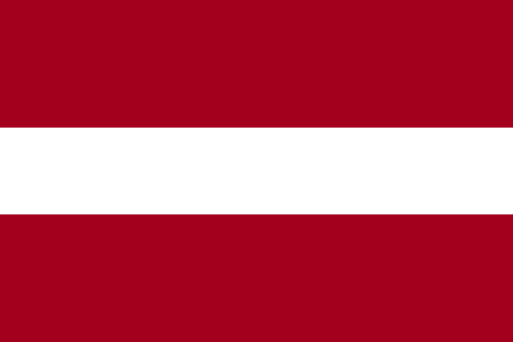
Photo by Diego Delso, CC BY-SA 3.0, via Wikimedia Commons
Overview
Latvia, officially the Republic of Latvia, is a country in the Baltic region of northern Europe. It is one of the three Baltic states, along with Estonia to the north and Lithuania to the south. It borders Russia to the east and Belarus to the southeast and shares a maritime border with Sweden to the west. Latvia covers an area of 64,573 km2 (24,932 sq mi), with a population of 1.83 million. The country has a temperate seasonal climate. Its capital and largest city is Riga. Latvians, who are the titular nation and comprise 65.5% of the country's population, belong to the ethnolinguistic group of the Balts and speak Latvian. Russians are the most prominent minority in the country, at almost a quarter of the population; 37.7% of the population speak Russian as their native tongue.
Text from Wikipedia, licensed CC BY-SA.
Where to go in Latvia


Hidden gems
Lesser-known places that travellers on Wikivoyage recommend beyond the main cities of Latvia: villages, national parks and quiet corners. The short descriptions come from those lists (CC BY-SA).

Ķemeri National Park
9 places listed
Forests and mires.

Slīteres National Park
8 places listed
Coastal national park on the Liv Coast.

Straupe
6 places listed
A large village, drawing its history from times, when somewhere in these region the largest fort of the Livonians existed. At the time of the Livonian Order, two castles were built in Straupe. Even though the city itself was part of the Hanseatic League, it was under the control of Riga, using it as an outpost for fighting the mighty Wenden. The wars of the second half of the 16th century completely destroyed Straupe. Later, it resurrected in the form of a village and apparently not quite where it was before.

Aglona
3 places listed
A village famous for its Basilica of the Assumption, 40 km northeast of Daugavpils.

Salaspils
1 place listed
15 km southeast of Riga where Salaspils concentration camp was located.

North Vidzeme Biosphere Reserve
No places listed yet
A reserve that covers 6% of the territory of Latvia, and offers hiking trails, beaches, and nature education.
Public holidays
National days off in Latvia in the next twelve months. Offices, banks and many shops close, and transport and stays get busier. Regional holidays and local festivals are not included, and holidays that follow the moon can move by a day.
- Christmas Eve · Ziemassvētku vakars
- Christmas Day · Ziemassvētki
- Boxing Day · Otrie Ziemassvētki
- New Year's Eve · Vecgada vakars
- New Year's Day · Jaunais Gads
- Good Friday · Lielā Piektdiena
- Easter Sunday · Lieldienas
- Easter Monday · Otrās Lieldienas
- Labour Day · Darba svētki
- Restoration of Independence day · Latvijas Republikas Neatkarības atjaunošanas diena
- Midsummer Eve · Līgo Diena
- Midsummer · Jāņi
- Republic Day · Latvijas Republikas proklamēšanas diena
Dates from the date-holidays project, based largely on Wikipedia (CC BY-SA 3.0). Check locally before you plan around a holiday.
Travelling in Latvia
Getting around the country
In Latvian, the word for street (as in street names) is iela. An example is Brīvības iela which is translated as Freedom street.
By car. National and regional roads in Latvia have been through a process of update since the accession to the European Union. All national roads are paved and are signposted in red with numbers from A1 to A15. Most of the national roads are also part of the European route grid of roads. 84% of the regional roads are paved and they are signposted in blue with numbers from P1 to P133. 78% of local roads are gravel roads and they are signposted in grey with numbers from V1 to V1489 — on maps, but not necessarily on the roads. The only motorway in Latvia is a 12-km stretch of the A7 around Ķekava, opened in 2023. Some national roads around Rīga are built to expressway standards and some have higher speed limits (110 km/h, indicated by signs) but are not classified as motorways. All gas stations around the country are self-service and available 24/7. Cirkle K, Neste and Viada operate gas stations all over the country, and there are many local companies as well. Diesel fuel and gasoline with octane ratings of 95 and 98 are widespread. Liquefied petroleum gas (LPG, autogāze) is quite common as well. Electric cars are not widespread as the network of charging stations has not yet developed to be viable for casual, everyday usage. The two main providers of public electric charging for vehicles are e-mobi and Elektrum Drive.
Money and costs
Money. Latvijas Banka (The Latvian National Bank) is the only place you can get commemorative €2 coins at nominal value and exchange euro banknotes to smaller or larger denomination euro banknotes without having to pay a fee. This can be done at the branch in Riga. Latvijas Banka's cashier's office in Riga also exchanges Latvian lats issued 1993 to 2013 at a fixed rate against euro. Tax free stores have their signs clearly displayed. ATMs are widely available throughout Latvia, including in Riga International Airport and even in many small towns. Banks will accept traveller's cheques with a fee, usually equal to or greater than 1% of the amount exchanged or a flat €10.
ISIC. If you are an EU student, bring your ISIC. Many places (museums, bus, etc.) in Latvia have great discounts for EU students with an ISIC.
Tipping. The tipping culture of Latvians is generally fairly reserved: usually rounding up the bill (around 5–10%) is enough, but not necessary. Make sure to check your receipt, as some (but few) establishments may automatically include a tip in the bill as service charge. Tips is dzeramnauda (drink money) in Latvian.
Shopping. Amber is sold in most souvenir shops. If you are lucky, some can sometimes be found on the Baltic Sea shore after a storm. Be careful looking for amber on beaches in western Latvia - the sea near Liepāja is polluted with phosphorus, which looks exactly the same, but can catch fire after drying out.
Language
Latvian (latviešu valoda) is the only official language in Latvia. Natively spoken by around 1.5 million people in Latvia and abroad (Ireland, United Kingdom, Canada, USA, Russia, Brazil and Australia), it belongs to the Baltic language group of Indo-European languages. It is related to Lithuanian but is different enough to be hard to grasp even for native Lithuanian speakers. Latgalian (latgalīšu volūda), spoken by roughly 10%, is closely related, officially regarded as a variant of Latvian, with equal legal status but still marginalized and not used in state institutions. The third language with official status is Livonian (līvõ kēļ), which became extinct in 2013 with the death of the last native speaker.
Customs and manners
Latvians in general are fairly reserved and generally respect others' personal space, for example, Latvians do not usually greet strangers unless introduced by someone. As with many countries in Europe, inquiring about someone's salary or talking about your own is uncommon and not recommended. Similarly, personal, political, or religious convictions are no-go areas until you're better acquainted with someone. Littering is considered bad manners and is against the law. Offenders may be fined. It is considered polite in Latvian culture to hold a door open for someone, let others board a bus or a train first etc. This applies to men letting women go first in particular. The swastika symbol (Latvian: ugunskrusts or pērkonkrusts, "fire cross" or "thunder cross") is a common ornament in embroideries in Latvian folk costumes and contemporary souvenirs and was considered a pagan religious symbol for centuries. It is supposed to bring luck, energy and fire. There is no connection of this symbol to Nazi Germany, and any attempts to hint at one will be considered offensive. You should be careful when talking to Latvians about politics and history, especially about the Soviet Union. As Latvia became a Soviet republic after World War II, many Latvians, especially of the older generations, have strong opinions about the topic.
Phones and internet
Telephone. {| class="wikitable" style="float: right; width:35%;" |-!! Bite! LMT! ZZ! Tele2 |-! 5G | style="color:black; background:#9F9; text-align:center" | yes | style="color:black; background:#9F9; text-align:center" | all big cities | style="color:black; background:#9F9; text-align:center" | yes (presumably same as Tele2) | style="color:black; background:#9F9; text-align:center" | yes |-! Tethering | style="color:black; background:#9F9; text-align:center" | yes | style="color:black; background:#9F9; text-align:center" | yes | style="text-align:center" | unknown | style="text-align:center" | unknown |-! unlimited data | style="color:black; background:#9F9; text-align:center" | yes | style="color:black; background:#9F9; text-align:center" | yes | style="text-align:center" | unknown | style="text-align:center" | unknown |-! eSIM | style="color:black; background:#9F9; text-align:center" | yes | style="color:black; background:#9F9; text-align:center" | yes | style="color:black; background:#9F9; text-align:center" | yes | style="color:black; background:#9F9; text-align:center" | yes |-!
Internet. Free WiFi is often available in hotels, cafés, libraries, intercity buses and the Riga International Airport.
Staying safe
It is generally safe to travel around Latvia on your own, although some petty crime exists. If travelling by bike, watch out for bicycle theft. Cyclists are a small minority in Latvian traffic, and dedicated bike lanes are rare. It is common practice that bikes drive on the pavement in larger cities. If travelling by car, try not to leave valuable things in plain sight in your car. Stay alert when driving on smaller roads, especially through forests, as wild animals may wander around. It is particularly important to keep that in mind during the night. Many Latvian drivers enjoy speeding and the traffic can often flow much faster than the laws allow. If travelling by foot, take care when crossing the roads as many Latvian drivers can be fairly reckless. It is considered bad mannered to consume alcoholic beverages in public, when not in bars, restaurants etc. Some places you might be fined when consuming alcoholic beverages out of a non-concealed bottle. Drunken behaviour like for example urinating in public will also get you a fine, or a night in jail. Local informational web-sites for tourists claim that, in terms of safety, there is almost no difference between big cities and country areas. Although it is true that anywhere in Latvia one is never too far from a town or a city, seeking help in case of emergency may be somewhat more difficult in the countryside (for foreign tourists), as few people speak English there.
From the Wikivoyage guide, written by travellers (CC BY-SA), shortened. For entry rules, visas, health and current safety, always check your government's official travel advice (linked above).