

Myanmar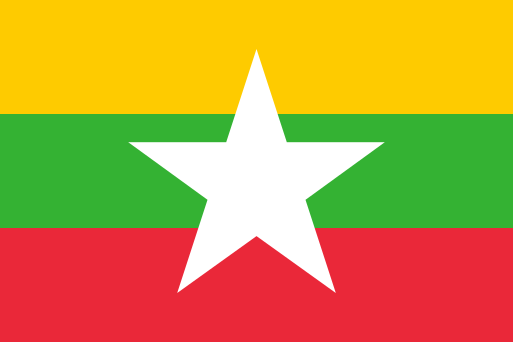
Photo by Wine Su11, CC BY-SA 4.0, via Wikimedia Commons
Overview
Myanmar, officially the Republic of the Union of Myanmar and also referred to as Burma, is a country in northwest Southeast Asia. It is the largest country by area in Mainland Southeast Asia and has a population of about 55 million. It is bordered by India and Bangladesh to the northwest, China to the northeast, Laos and Thailand to the east and southeast, and the Andaman Sea and the Bay of Bengal to the south and southwest. The country's capital city is Naypyidaw, while its largest city is Yangon.
Text from Wikipedia, licensed CC BY-SA.
Where to go in Myanmar


Hidden gems
Lesser-known places that travellers on Wikivoyage recommend beyond the main cities of Myanmar: villages, national parks and quiet corners. The short descriptions come from those lists (CC BY-SA).

Inle Lake
35 places listed
A large shallow lake famous for boat trips, visiting floating villages inhabited by the Intha people, hiking, and also a source of excellent silk

Mrauk U
33 places listed
Former capital of the Rakhine Kingdom, with many ancient pagodas that serve as a reminder of that era

Ngapali
26 places listed
Beach resort in western Rakhine State, on the Bay of Bengal

Ngwe Saung
23 places listed
Longest stretch of beach in Ayeyarwaddy (English: Irrawaddy) Division, white sandy beach and crystal clear water are the features of Ngwe Saung Beach

Pyay
23 places listed
A town on the Irrawaddy River midway between Yangon and Bagan, known for its archaeological site Sri Kittara, the ancient Pyu capital from 2 to 9 CE

Pathein
20 places listed
A river town in the Irrawaddy delta, known for manufacture of umbrellas, gateway to Chuang Tha and Ngwe Saung Beaches

Kyaiktiyo
15 places listed
A gold-gilded rock sitting atop a cliff and a major pilgrimage site

Chaung Tha
12 places listed
Chaungtha is a town and beach resort located in Shwethaungyan Subtownship, Pathein Township, Ayeyarwady Region, Myanmar. Chaungtha Beach, as it is more commonly known, is about 5 hours' drive away from Yangon, and is a popular resort with Yangonites from October to April. As it is relatively more affordable than the nearby Ngwesaung and Ngapali beaches, Chaungtha is also more crowded and less clean than the two more expensive and better maintained beaches.

Kengtung
12 places listed
Between Mong La (on the border with China) and Tachileik (on the border with Thailand) in the Golden Triangle, known for the Ann (black teeth people) and Akha tribes and trekking

Mount Popa
5 places listed
An extinct volcano regarded as the Mount Olympus of Myanmar, a green oasis high above the hot plains and an easy day trip from Bagan

Nat Ma Taung
No places listed yet
Nat Ma Taung, also known as Mount Victoria, is the highest mountain in Chin State of Northwestern Myanmar.
Taukkyan
1 place listed
The site of the war cemetery with the graves of more than 6,000 Allied soldiers who perished in Burma during World War II.
Travelling in Myanmar
Getting around the country
Myanmar's infrastructure is in poor shape. Travel to certain regions is prohibited; for others, special permits must be obtained, and a guide/interpreter/minder may be mandatory - although whether these "guides" accompany you to look after you, or to keep you from going to places the government doesn't want you to see, is a question best discussed elsewhere. However, travel between the main tourist sites, namely Mandalay, Bagan, Inle Lake and Yangon, is fairly straightforward.
Restricted areas. Much of Myanmar is closed to foreign travellers, and many land routes to far-flung areas are also closed (for example, to Mrauk U, Kalewa, Putao, Kengtung). Due to longstanding ethnic conflicts, many ethnic minority areas are controlled by armed separatist groups and remain outside the control of the central government. Thus, while tourists can travel freely in the Bamar-majority Burmese heartland, travel tends to be restricted or circumscribed in ethnic minority areas. In theory, any tourist can apply for a permit to visit any restricted area or to travel on any restricted land route. In practice, it is unlikely that any such permit will be issued in a reasonable amount of time, or at all. Permit requests can be made locally in some cases (for example, requests for the land route to Kalewa can be made in Shwebo) but, in most cases, the request has to be made in Yangon.
By plane. {| class="wikitable" style="float:right;" |+ Sample fares between important destinations (through local tourist agency)! From!! To!!
Money and costs
Money. Myanmar's currency is the kyat, pronounced "chat". Prices may be shown locally using the abbreviation of K (singular or plural) or Ks (plural) either before or after the amount and depending very much on who is doing the sign writing. The ISO abbreviation is MMK. Wikivoyage articles will use kyat to denote the currency. Pya are coins, and are rarely seen since their value has become increasingly insignificant with even the largest 50 pya coin worth less than US$0.001. Banknotes of Myanmar are issued in denominations of 50, 100, 200, 500, 1,000, 5,000, and 10,000 kyats. You may also come across 20, 10, 5, and 1 kyat and 50 pya banknotes. They are valid but rarely found and best held onto as souvenirs. Older banknotes in strange denominations are sold to tourists and, while typically genuine, are rarely if ever valuable. The notes of 50 kyat, 100 kyat, 200 kyat, and 500 kyat are usually in a horrible condition, but are generally accepted when making small purchases. The 1,000 kyat notes are slightly better. 5,000 and 10,000 kyat notes always appear new after exchanging foreign currencies. When exchanging money, check that the banknotes you receive are in a generally good condition. If the exchange gives you kyat notes in horrible condition, you can ask them to exchange them for notes in better condition. Dispose of remaining kyat before leaving. Outside of Myanmar, kyat is almost worthless but do make nice souvenirs.
US dollars. Foreigners are no longer required to pay in U.S.
Language
The official language of Myanmar is Burmese (မြန်မာစကား mien ma za ga) (known by the government as Myanmar), a Sino-Tibetan language related to Chinese and hence tonal (word pitch matters) and analytic (most words are one syllable long). It is written using the Burmese script, based on the ancient Pali script. Bilingual signs (English and Burmese) are available in most tourist spots. Numbers often are also written in Burmese script. Much vocabulary is derived from another ancient languages of Pali (at the time of Buddha) and Sanskrit. There are also many other ethnic groups in Myanmar such as the Mon, Shan, Pa-O, Rohingya and many others who continue to speak their own languages.
Customs and manners
, the old capital of Rakhine in Myanmar]] Modest clothing is highly appreciated everywhere except nightclubs, and practically required in religious places such as pagodas, temples and monasteries (of which there are thousands). Miniskirts, shorts and sleeveless shirts are not allowed in consecrated areas, where you also have to remove your footwear, so loafers and flip-flops that you can slip on and off at the entrance are preferable. Myanmar has some of the most stunning temples in Asia and you will be tempted to visit more than you think. In Myanmar, you have to remove your footwear before entering the entire temple complex, including in outdoor areas. You might want to bring some wet wipes so you can clean your feet after visiting. Burmese people generally do not engage in public display of affection, even among married couples, and it is generally considered distasteful and should be avoided. Both men and women wear a longyi, a sort of sarong sold everywhere, and it is not unusual to see Caucasian foreigners walking around in them. They are wrapped in different ways for men and women, so find out how to tie yours. If you turn up at a temple in inappropriate dress, you can always rent a longyi for a pittance. When giving and receiving business cards, always use your right hand with the palm facing up, and your left hand supporting your right elbow. As the left hand is traditionally reserved for dirty things, handling business cards with it is considered to be very rude.
Phones and internet
Telephone. Country Code: +95 International Call Prefix: 00 Phone numbers in Myanmar have the format +95 1 234-5678 where "95" is the country code for Myanmar, the next one, two, three or four digits are the area code and the remaining 6, 7 or 8 digits are the "local" part of the subscriber number. You can buy GSM/4G sim cards at International airports or any convenience store. Standard sim card costs around 1500 Ks. Some operators may offer special sim for tourists. There are 4 mobile operators in Myanmar, MPT (Government+KDDI), Telenor, Ooredoo and MyTel (Military+VietTel). MPT in the largest in Myanmar in terms of network coverage and user. Operators offer similar price plans. Generally, standard plan offers voice calls for 20 Ks - 25Ks/min, SMS at 15 Ks - 20 Ks/message. Pay as you go data plan offers around 7 Ks/MB but specific data plan will offer around 1000 Ks/GB or cheaper. Prices for IDD and roaming service vary depending on the operators and destination countries. If you are going to use in urban area only for local call and data, there is not much difference between operators. If you are going to visit remote area, please check which operator is available at there.
Staying safe
Crime. The government punishes crime, particularly against tourists, severely; as a result, as far as crime and personal safety go, Myanmar is extremely safe for tourists, and it is generally safe to walk on the streets alone at night. In fact, you are less likely to be a victim of crime in Myanmar than in Thailand or Malaysia. However, as with anywhere else, little crime does not mean no crime and it is still no excuse to ditch your common sense. As a foreigner, the most common crime you should be worried about is petty theft, so keep your belongings secured. Physical and verbal harassment towards foreigners is uncommon, even on urban walks near bars. Since 2005, Yangon and Mandalay have seen a barely perceptible rise in the very low level of street robberies. There were isolated bombings in 2005 in Mandalay and Yangon, and in 2006 in Bago.
Begging. Despite traditional taboos against it, begging has become a major problem in the main tourist areas such as Bago and Bagan. Children and "mothers" carrying babies are often the ones who beg as they are more effective at soliciting pity. Most beggars are part of larger begging syndicates or just after easy money, as tourists are usually seen to be rich. In addition, the poor can always obtain food for free from the nearest monastery if they can't afford to pay for it, so begging is not necessary for their survival.
Fake monks. Theravada Buddhism is the main religion in Myanmar, and it is customary for monks to go on alms rounds in the morning.
From the Wikivoyage guide, written by travellers (CC BY-SA), shortened. For entry rules, visas, health and current safety, always check your government's official travel advice (linked above).